
The Night Watch by Rembrandt (2026): Complete Visitor's Guide
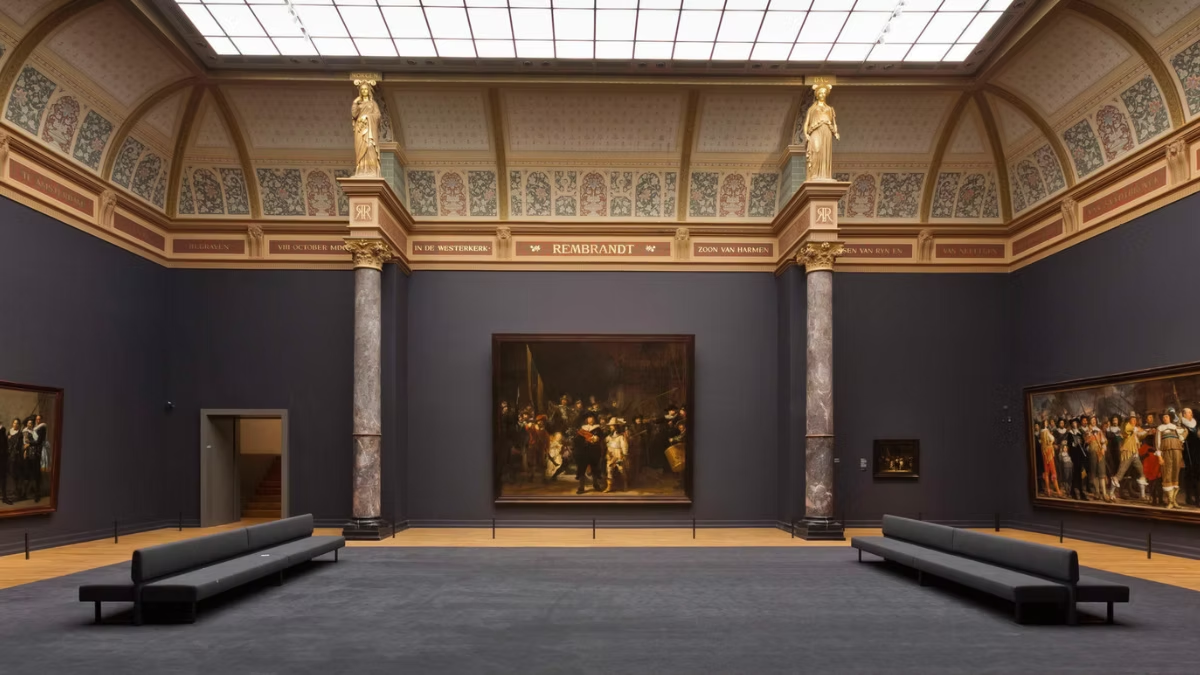
The Night Watch (1642) by Rembrandt van Rijn is the most famous painting in the Rijksmuseum and the most important Dutch painting in existence. It’s a monumental group portrait of an Amsterdam militia company — over 3.63 metres tall and 4.37 metres wide — displayed in its own purpose-built hall at the end of the Gallery of Honour on Floor 2. Since 2019 it’s been undergoing Operation Night Watch, the largest restoration study in the painting’s history, with conservators often visible working on it behind a specially constructed glass chamber. Free to see with any Rijksmuseum entry ticket (€25 adult, free under 18). Best viewed in the first 30 minutes of opening (9:00 AM) before the crowds arrive.
Almost every visitor to the Rijksmuseum comes to see The Night Watch, often without fully knowing why. This is the painting that made Rembrandt’s reputation in 1642, that has survived a knife attack, two world wars, and centuries of moves and renovations, and that’s currently the subject of the most intensive scientific study ever conducted on a single artwork. This guide covers exactly what you’re looking at, where to find it, how to see it around the crowds, and what Operation Night Watch is actually revealing about the painting.
What Is The Night Watch?
The Night Watch is the popular name for Rembrandt’s painting “Militia Company of District II under the Command of Captain Frans Banninck Cocq” (1642). It’s a group portrait of an Amsterdam militia company — a civilian defence guard made up of wealthy local citizens — commissioned to hang in their meeting hall. What made it revolutionary is that it broke from the static, rigid group-portrait tradition of the time: instead of lining up his subjects side by side, Rembrandt caught them mid-motion, with Captain Banninck Cocq and Lieutenant Willem van Ruytenburgh stepping forward as if emerging from the canvas.
Key facts at a glance
| Fact | Detail |
|---|---|
| Full title | Militia Company of District II under the Command of Captain Frans Banninck Cocq |
| Common name | The Night Watch (De Nachtwacht in Dutch) |
| Artist | Rembrandt van Rijn (1606-1669) |
| Date completed | 1642 |
| Medium | Oil on canvas |
| Dimensions | 363 × 437 cm (11'11" × 14'4") |
| Location | Night Watch Room, Floor 2, Rijksmuseum |
| Current state | Undergoing Operation Night Watch restoration (2019-present) |
| Insurance value | Unofficial estimates exceed €500 million |
| Access | Included with standard Rijksmuseum entry ticket |
Why it’s called “The Night Watch”
The painting’s popular name is a misunderstanding. For most of the last 200 years, the canvas was covered in layers of darkened varnish that made the scene appear to take place at night. In the 1940s, conservators cleaned the painting and discovered the scene is actually set in daylight — the varnish had yellowed and darkened over centuries, making the brightly-lit figures appear to be lantern-lit at night. By that point, “The Night Watch” was so entrenched as the name that it stuck. It’s a daytime scene with dramatic lighting, not a nighttime one.
Where to Find The Night Watch
The Night Watch hangs in the Night Watch Room (room 2.30) at the end of the Gallery of Honour on Floor 2. From the Rijksmuseum entrance on Floor 0, take the stairs or lift up two flights to Floor 2. Enter the Great Hall, walk through the Gallery of Honour (passing the Vermeers and other Golden Age masters), and the Night Watch Room is the last room at the far end. The painting is visible from about 30 metres away as you walk into the gallery.
Navigation step by step
- Enter the museum on Floor 0 (the main atrium)
- Take the staircase or lift up two floors — lifts are in both rooms next to the cloakroom
- On Floor 2, enter the Great Hall (Voorhal) — the ceremonial entryway with stained glass and mosaic floors
- Walk into the Gallery of Honour (Eregalerij) — a long, cathedral-like space with alcoves on both sides
- Continue straight to the end — the Night Watch Room is the final chamber
- The painting fills the far wall of the Night Watch Room, behind a glass chamber used for the ongoing restoration
See Rijksmuseum Floor Plan & Map for the full layout.
What the room is like
The Night Watch Room was built specifically to house the painting after the 2013 museum renovation. It’s larger than most Rijksmuseum galleries, with enough space for the painting to be viewed from 15-20 metres back — the distance Rembrandt designed it to be seen from. Since 2019, a glass chamber has been installed around the painting where conservators work on the Operation Night Watch restoration in full public view. On most weekdays you can see restorers physically working on the canvas.
How to See The Night Watch Without the Crowds
Between 10:30 AM and 3:00 PM, the Night Watch Room is genuinely crowded — you’ll be waiting in a loose queue to get a clear view of the painting. To see it properly:
Best options:
- 9:00 AM (opening) — the 9 AM timed slot is the single best time. Walk directly from the entrance to Floor 2 and head straight to the Night Watch Room. You’ll have it nearly to yourself for 15-20 minutes.
- 4:30 PM (last entry) — the final 30 minutes before closing also thin out as tour groups clear
- Weekday mornings (Tuesday-Thursday) — quieter than weekend mornings by a significant margin
Avoid:
- 11 AM to 2 PM weekends — 40-50 people in the room at once, shoulder-to-shoulder at the front
- Peak tour times (late morning) — guided tours arrive in 15-person blocks
See Opening Hours & Best Times to Visit for a fuller breakdown.
What to Look For in the Painting
The composition
The painting shows 34 identifiable people — 18 militiamen who paid to be portrayed (the paying clients), plus 16 additional figures Rembrandt added for dramatic effect (children, a dog, extra soldiers to fill the composition). The scene depicts the company leaving their meeting hall, with Captain Frans Banninck Cocq in black at centre-left, Lieutenant Willem van Ruytenburgh in yellow next to him, and the rest of the company fanning out around them.
The figures worth studying
- Captain Banninck Cocq (in black, centre-left) — wealthy grain trader, later a burgomaster of Amsterdam. His paying-client fee was about 100 guilders (roughly €10,000 in modern money).
- Lieutenant Van Ruytenburgh (in yellow, centre-right) — younger, lower rank but painted as Cocq’s equal. The yellow is significant — Rembrandt used expensive lead-tin yellow pigment here, a high-status choice.
- The girl in yellow (left-centre, behind the captain) — painted much smaller than proper perspective would allow, glowing brightly. She’s carrying a chicken with prominent claws — the claws (klauwen) are a symbol of the musketeer militia. She’s not a real person but a compositional device.
- The drummer (far right) — real person, one of the figures Rembrandt added beyond the paying group.
- The dog (lower centre, barking) — in the original, the dog appears to bark at the drummer. A famous detail that’s often overlooked.
The technical innovations
Three things make this painting genuinely revolutionary:
- Motion in a group portrait. Earlier group portraits were static — rows of faces. Rembrandt put his subjects in motion, walking forward, looking in different directions.
- Light as drama. Rembrandt used theatrical stage-lighting techniques — bright spotlight on Van Ruytenburgh, dramatic shadow on the rest of the composition.
- Scale and ambition. Over 11 × 14 feet, this was one of the largest paintings ever commissioned for a civic space in 17th-century Amsterdam.
The Painting’s History
The Night Watch has had a dramatic 380-year history. Commissioned in 1639 and completed in 1642, it hung in Amsterdam’s Kloveniersdoelen (the militia’s meeting hall). In 1715 it was moved to Amsterdam’s Town Hall, which required cutting strips off all four sides — about 60 cm from the left — to fit. It has survived three knife attacks (1911, 1975, and 1990), two World Wars (it was evacuated and hidden from the Nazis), and dozens of cleanings and restorations. Since 2019, it has been undergoing Operation Night Watch, the largest restoration project in its history.
The 1715 trimming
When the painting moved to Amsterdam’s Town Hall in 1715, it was cut down on all four sides to fit between two pillars. About 60 cm was removed from the left side, with smaller strips from the top, right, and bottom. The 2021 Operation Night Watch team used AI-generated reconstruction based on a 17th-century copy by Gerrit Lundens to digitally restore the missing portions, showing what the original full composition looked like.
The three attacks
- 1911: A cobbler attacked the painting with a knife. Minor damage.
- 1975: A mentally ill schoolteacher slashed the canvas with a bread knife, causing 12 significant cuts. The painting underwent years of restoration.
- 1990: Another visitor threw acid on the painting. Staff were able to wash it off before significant damage occurred.
World War II
During the German occupation of the Netherlands in WWII, The Night Watch was removed from its frame, rolled up, and hidden in the Sint Pietersberg caves in the southeast Netherlands for the duration of the war. It was returned to the Rijksmuseum in 1946.
Operation Night Watch: The Current Restoration
Operation Night Watch began on July 8, 2019 and is the most intensive scientific study ever conducted on a single painting. The conservation team works in a glass chamber constructed around the painting, visible to museum visitors throughout the workday.
What the restoration is actually doing
- Removing yellowed varnish — the painting’s surface has darkened over decades
- Mapping the original pigments using hyperspectral imaging, X-ray fluorescence, and macro-photography
- Creating the highest-resolution photograph of any painting in history — over 700 gigapixels, so detailed you can see individual brushstrokes and the weave of the canvas
- Reconstructing missing sections using AI analysis of the 17th-century Lundens copy
- Documenting every change the painting has undergone since 1642
How long will it take?
The project has been ongoing since 2019 with no firm end date. The team expects the restoration will continue through 2026-2028 at minimum. Throughout the process, the painting remains on display — the glass chamber is designed to let visitors see both the painting and the conservators at work.
What you can see at the museum during restoration
- The painting itself — fully visible behind the glass
- Conservators working — typically 2-4 specialists on the canvas during working hours
- Restoration-progress displays — screens in the Night Watch Room show hyperspectral imaging and discovery findings in real time
- The ultra-high-resolution image — accessible via iPad kiosks in the room, letting you zoom in on the painting to microscopic detail
Visitors sometimes assume the glass chamber blocks photography. It doesn’t — you can photograph The Night Watch through the glass (no flash, handheld only; see Photography Rules). The glass may introduce slight reflections depending on angle.
The Night Watch in Popular Culture
The painting has been referenced, parodied, and reimagined endlessly:
- Peter Greenaway’s 2007 film “Nightwatching” — a fictional imagining of the painting’s creation
- Countless satirical reinterpretations — swapping figures for celebrities, historical figures, or fictional characters
- Referenced in literature from Proust to contemporary Dutch fiction
- Hugely influential on later group portraiture — every military commission portrait for 200 years after 1642 was measured against it
Frequently Asked Questions
Where is The Night Watch displayed?
In the Night Watch Room (Room 2.30) at the end of the Gallery of Honour on Floor 2 of the Rijksmuseum in Amsterdam.
Who painted The Night Watch?
Rembrandt van Rijn (1606-1669), the Dutch Golden Age’s most famous painter. He completed it in 1642 when he was 36 years old and at the peak of his career.
Is The Night Watch free to see?
It’s included with any standard Rijksmuseum entry ticket (€25 adult, free for under-18s). There’s no separate ticket just for The Night Watch.
How big is The Night Watch painting?
363 × 437 cm (approximately 12 feet by 14.5 feet). It originally was larger — about 60 cm was cut off the left side in 1715 when the painting was moved to Amsterdam’s Town Hall.
Why is it called “The Night Watch” if it’s a daytime scene?
The painting’s surface was darkened for centuries by yellowed varnish, making the scene appear to be at night. Only in the 1940s did conservators clean it enough to reveal the scene is actually set in bright daylight. The “Night Watch” name had become so universal by then that it stuck.
Can I photograph The Night Watch?
Yes. Handheld personal photography is allowed without flash. Tripods, monopods, selfie sticks, and flash are not permitted. See Rijksmuseum Photography Rules.
How much is The Night Watch worth?
The painting has no official sale value because it will never be sold — it’s owned by the Dutch state and permanently displayed at the Rijksmuseum. Insurance-related estimates have ranged from €500 million to over €1 billion, but these are speculative.
Has The Night Watch been attacked?
Yes, three times: in 1911 (knife attack, minor damage), 1975 (serious knife attack with 12 cuts, repaired over years), and 1990 (acid attack, washed off before significant damage).
What is Operation Night Watch?
The largest scientific study and restoration project ever conducted on a single painting, running since 2019. Conservators work on the painting in a glass chamber visible to museum visitors. The project includes hyperspectral imaging, AI-based reconstruction of the trimmed portions, and creating the highest-resolution photograph of any painting in history.
When is the best time to see The Night Watch without crowds?
The 9:00 AM opening slot on a weekday (Tuesday-Thursday) gives you 15-20 minutes with the painting nearly empty. After 10:30 AM until 3:00 PM, the Night Watch Room is consistently crowded. The last 30 minutes before closing (4:30-5:00 PM) is the second-quietest window.
Can I see where the painting was trimmed?
Not in the physical painting, but the Rijksmuseum has displayed the AI-reconstructed full original as a high-resolution projection alongside the painting in recent special exhibitions. The reconstruction is also viewable in detail at rijksmuseum.nl.
