
The Threatened Swan by Jan Asselijn (2026): Meaning, History & Location
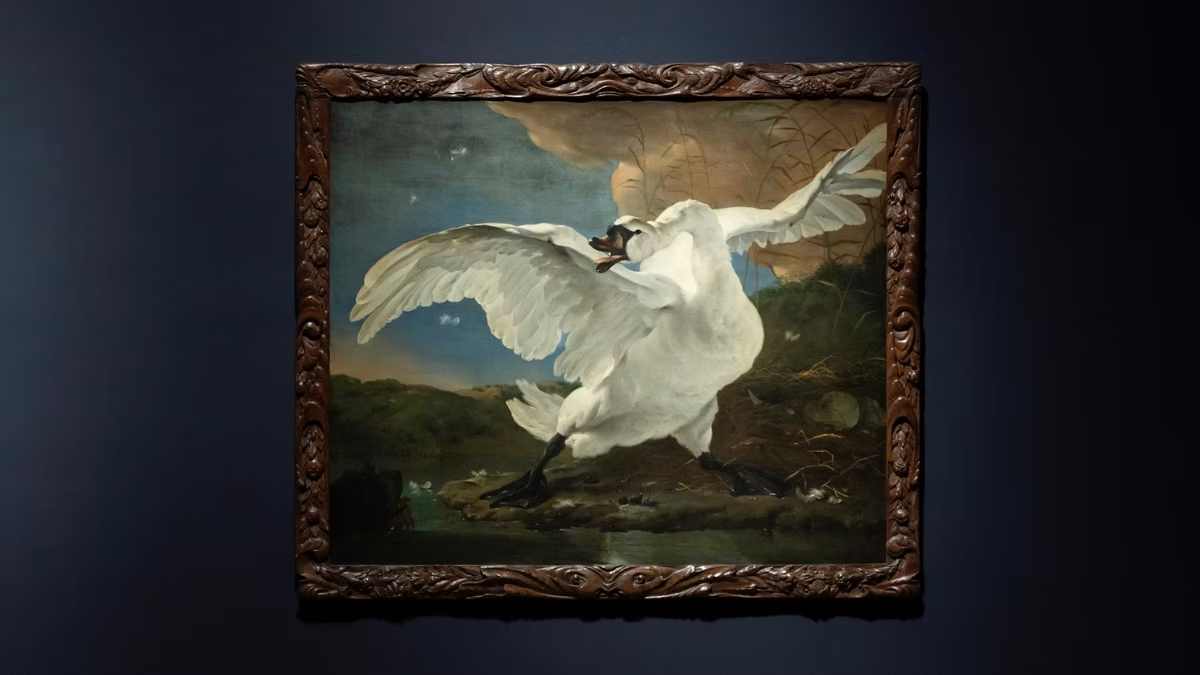
The Threatened Swan (c. 1650) by Jan Asselijn is one of the most visually arresting paintings in the Rijksmuseum — a large canvas (144 × 171 cm) showing a white swan with wings spread and beak open, hissing in defence of its nest against an unseen threat. Asselijn originally painted it as a straightforward nature scene, but by the late 17th century it had been reinterpreted as a political allegory: the swan became a symbol of Johan de Witt, the Dutch Grand Pensionary who led the Republic, defending the Netherlands against its enemies. The painting hangs in the Gallery of Honour on Floor 2 of the Rijksmuseum, and its dramatic composition — an enraged white swan filling the canvas — stops visitors in their tracks. Free to see with standard entry (€25 adult, free under 18).
Most visitors to the Rijksmuseum’s Gallery of Honour expect Rembrandts and Vermeers. The Threatened Swan catches them off guard. It’s not a portrait, a genre scene, or a landscape — it’s a single bird, rendered life-size and fighting for its territory. The painting is among the most photographed in the museum despite rarely appearing on lists of “most famous Dutch paintings,” and its transformation from nature study to political symbol is one of Dutch art history’s stranger stories.
What Is The Threatened Swan?
The Threatened Swan is an oil painting on canvas by the Dutch Golden Age painter Jan Asselijn (c. 1610-1652), completed around 1650. It depicts a mute swan, wings spread, hissing aggressively at an unseen threat — likely the small dog visible in the lower left corner. The swan stands on a small mound of vegetation; its nest with eggs is visible behind it. Asselijn painted it as a nature scene celebrating the drama of protective animal behaviour. A century later, Dutch viewers re-interpreted it as a political allegory of national self-defence. It was one of the first paintings to enter the Rijksmuseum’s collection when the institution opened in the early 1800s.
Key facts at a glance
| Fact | Detail |
|---|---|
| Title | The Threatened Swan (De Bedreigde Zwaan) |
| Artist | Jan Asselijn (c. 1610-1652) |
| Date | c. 1650 |
| Medium | Oil on canvas |
| Dimensions | 144 × 171 cm |
| Location | Gallery of Honour, Floor 2, Rijksmuseum |
| Acquired by Rijksmuseum | 1800 (one of the earliest works in the collection) |
| Access | Included with standard Rijksmuseum entry ticket |
Where to Find The Threatened Swan
The Threatened Swan hangs in the Gallery of Honour on Floor 2 of the Rijksmuseum. From the main atrium on Floor 0, take the stairs or lift up two flights. Enter the Great Hall and then the Gallery of Honour. The painting is in one of the alcoves on the right side of the gallery as you walk from the Great Hall toward the Night Watch Room. Its size (roughly 4.7 × 5.6 feet) and dramatic white-on-dark composition make it visible from across the gallery.
Navigation
- Enter the museum on Floor 0 — the main atrium
- Take the stairs or lift up two floors to Floor 2
- Enter the Great Hall (Voorhal) — the stained-glass ceremonial entrance
- Walk into the Gallery of Honour (Eregalerij)
- Look into the alcoves on your right as you walk toward the Night Watch Room
- The Threatened Swan is among the most dramatic paintings in its alcove — a large white swan occupies most of the canvas
See Rijksmuseum Floor Plan & Map.
Who Was Jan Asselijn?
Jan Asselijn (c. 1610-1652) was a Dutch Golden Age painter born in Dieppe, France, to a family that had fled Flanders during the religious conflicts of the late 16th century. He lived most of his life in Amsterdam and spent several years in Rome (c. 1635-1646) — part of the “Bamboccianti” circle of Northern European painters working in Italy.
What Asselijn painted
- Italian landscapes — harbour scenes, ruins, pastoral views influenced by Italian sunlight
- Animal studies — of which The Threatened Swan is by far his most famous
- Small genre scenes — soldiers, travellers, everyday Italian and Dutch life
He worked faster and looser than many contemporaries — his brushwork is typically visible and energetic. The Threatened Swan is atypical of his output in scale and subject but characteristic in its dynamic handling.
He died young — around 1652, aged approximately 42. Like Vermeer (who died at 43) and Frans Hals’ son (who died at 36), Asselijn’s short life is a reminder of how compressed many Dutch Golden Age careers were.
What to Look For in the Painting
The swan itself
This is where the painting lives. Asselijn paints the bird life-size, with extraordinary attention to:
- The spread wings — feathers individually articulated, with movement implied in their tension
- The open beak — hissing, not silent; you can almost hear it
- The raised neck — aggressive posture of a threatened mute swan defending territory
- The white plumage — painted with subtle grey shadows showing feather layering
- The red of the beak base — the one bright colour anchoring the otherwise white-and-grey composition
The nest
Behind the swan, slightly to the right, is a small mound of vegetation and eggs — the nest the swan is defending. Easy to miss but essential to the painting’s narrative. Without the nest, the swan is just threatening; with it, we understand why.
The small dog
In the lower left corner, a small black-and-white dog appears — the threat the swan is addressing. It’s disproportionately small for the actual confrontation (a dog at that scale couldn’t threaten a mute swan), which is part of what signals that the painting is meant to be read symbolically rather than naturalistically.
The background
Dark, indistinct — typical of Dutch Golden Age animal paintings. The dark background throws the white swan into stark relief. Asselijn uses the contrast to heighten the drama.
The composition
Asselijn uses a strong triangular composition — the swan’s head at the top, the spread wings forming the sides, the nest and dog grounding the base. This is classical Renaissance compositional structure applied to a nature subject.
From Nature Scene to Political Allegory
The most interesting thing about The Threatened Swan is how its meaning shifted over time.
Asselijn’s original intent (c. 1650)
The painting was a straightforward animal study showcasing Asselijn’s ability to capture dramatic nature. Dutch viewers in 1650 were sophisticated consumers of animal paintings — there were specialists painting birds, fish, horses, cattle — and Asselijn’s swan was understood as an ambitious example of the genre.
The nest-defending swan wasn’t unusual as a subject; the drama came from Asselijn’s handling rather than the theme.
The political reinterpretation (late 17th century)
After Johan de Witt (1625-1672), the Dutch Grand Pensionary who effectively led the Republic for 20 years, was lynched by a political mob in 1672, patriotic viewers began reinterpreting the painting as an allegory:
- The swan = Johan de Witt, defending the Netherlands
- The nest = the Dutch Republic, under threat
- The dog = the enemies of the Republic (Louis XIV’s France, England, various internal factions)
Someone added inscriptions to the painting in the late 17th century making the allegory explicit — “de raadspensionaris” (“the Grand Pensionary”) was added above the swan, “Holland” was added above the eggs, and “de vijand van de staat” (“the enemy of the state”) was added above the dog. These inscriptions are still visible on the painting today.
The inscriptions are a later addition
Important: Asselijn did not add these inscriptions. They were painted on decades after his death, by someone who wanted to reframe the painting politically. For this reason, modern scholars treat them as historical additions rather than original authorial intent.
You can see the inscriptions on the actual painting — they’re visible in good lighting as faint lettering added to the dark background and nest area.
Why the political reading stuck
The reinterpretation became so culturally embedded that for over two centuries, most Dutch viewers encountered the painting as a political allegory rather than a nature scene. It hung in Dutch civic buildings as a patriotic symbol, was reproduced in Dutch patriotic publications, and became one of the first works transferred to the Rijksmuseum when it was founded.
Even today, the painting is often labelled in both ways — “The Threatened Swan” (literal) and sometimes “Allegory of Johan de Witt” (political).
Why This Painting Matters
Beyond the allegorical history, The Threatened Swan is important for several reasons:
As early Dutch animal painting
Asselijn was one of the first Dutch painters to treat a single animal at life-size as a worthy subject for a large-scale serious painting. This became a Dutch specialty — Melchior d’Hondecoeter (who painted exotic birds) and Paulus Potter (who painted cattle) are better known today, but Asselijn’s Threatened Swan preceded them and established the tradition.
As visual invention
The composition is striking even 375 years later. The white bird against the dark background, the sense of motion and threat, the psychological intensity — these are all aspects that modern viewers respond to immediately without needing the allegorical context.
As museum history
The Threatened Swan was one of the earliest paintings to enter the Rijksmuseum’s collection, transferred from the Dutch National Gallery when the Rijksmuseum was founded in 1800. It has hung in various Rijksmuseum locations for over 220 years continuously — one of the longest-displayed works in the collection.
As social document
The history of how viewers reinterpreted the painting — from nature study to political allegory — is a case study in how artworks gain meaning over time. Modern museum labels explicitly note this history.
Visitor Experience Notes
The painting’s scale surprises visitors
On screens or in books, The Threatened Swan looks like a medium-sized painting. In person, at 144 × 171 cm, it’s substantially larger than most visitors expect. The swan is approximately life-sized, and the painting’s scale is part of its impact.
It’s a genuine photo moment
The dramatic white-on-dark composition photographs well (unlike many Rembrandts and Vermeers, which have subtle tonal ranges that phones struggle to capture). Many visitors take pictures specifically of this painting.
Less crowded than the Rembrandts and Vermeers
The alcove tends to have fewer people at any given time than the Vermeer alcove or the Night Watch Room. This makes it one of the easier paintings to photograph and study without waiting.
Frequently Asked Questions
Where is The Threatened Swan at the Rijksmuseum?
In the Gallery of Honour on Floor 2. Walk from the Great Hall toward the Night Watch Room; the painting is in one of the alcoves on your right.
Who painted The Threatened Swan?
Jan Asselijn (c. 1610-1652), a Dutch Golden Age painter born in France to a family that had fled Flanders during the religious wars. He spent several years in Rome and worked mainly in Amsterdam.
When was The Threatened Swan painted?
Around 1650, making it roughly contemporary with Rembrandt’s Night Watch (1642) and Vermeer’s early mature works.
What does The Threatened Swan symbolise?
Two answers depending on when you ask. Originally (c. 1650), it was a straightforward nature painting of a swan defending its nest. In the late 17th century, Dutch viewers reinterpreted it as a political allegory: the swan represented Johan de Witt, the Dutch Grand Pensionary, defending the Republic against its enemies. Later inscriptions were added to the painting making the allegory explicit. Modern interpretation acknowledges both readings.
How big is The Threatened Swan?
144 × 171 cm (approximately 4.7 × 5.6 feet) — larger than most visitors expect. The swan itself is approximately life-sized.
Who was Johan de Witt?
Johan de Witt (1625-1672) was the Grand Pensionary of Holland and the effective political leader of the Dutch Republic from 1653 until his murder by a political mob in 1672. A skilled statesman who led the Netherlands through the First Anglo-Dutch War; his violent death traumatised the country. The later political reinterpretation of The Threatened Swan cast him as the defender-of-the-nation figure embodied by the swan.
Are the inscriptions on the painting original?
No. The inscriptions reading “the Grand Pensionary,” “Holland,” and “the enemy of the state” were added to the painting decades after Asselijn’s death by someone imposing a political interpretation. They’re visible on the canvas today but are historical additions, not original authorial elements.
Is The Threatened Swan included in the standard Rijksmuseum ticket?
Yes. Access to the Gallery of Honour, where this painting hangs, is included with any standard €25 adult entry ticket (free for under-18s).
Can I photograph The Threatened Swan?
Yes. Handheld photography without flash is permitted throughout the Rijksmuseum. The painting’s strong white-on-dark contrast means it photographs particularly well with phone cameras. See Rijksmuseum Photography Rules.
How does The Threatened Swan compare to other animal paintings at the Rijksmuseum?
The Rijksmuseum has several notable animal paintings including works by Melchior d’Hondecoeter (exotic birds) and Paulus Potter (cattle and livestock). Asselijn’s Threatened Swan predates most of these and established the Dutch tradition of single-animal life-size painting. See Dutch Golden Age Painting: A Beginner’s Guide.
Is this Asselijn’s most famous painting?
Yes by a significant margin. Asselijn painted mostly Italian landscapes and small genre scenes, but none approach The Threatened Swan’s fame. In most reference works, he’s identified primarily as “the painter of The Threatened Swan” — a single-work reputation similar to how Jan Asselijn’s contemporary Pieter Saenredam is known primarily for his church interiors.
