
Rijksmuseum Floor Plan & Map (2026): Navigate All 4 Floors
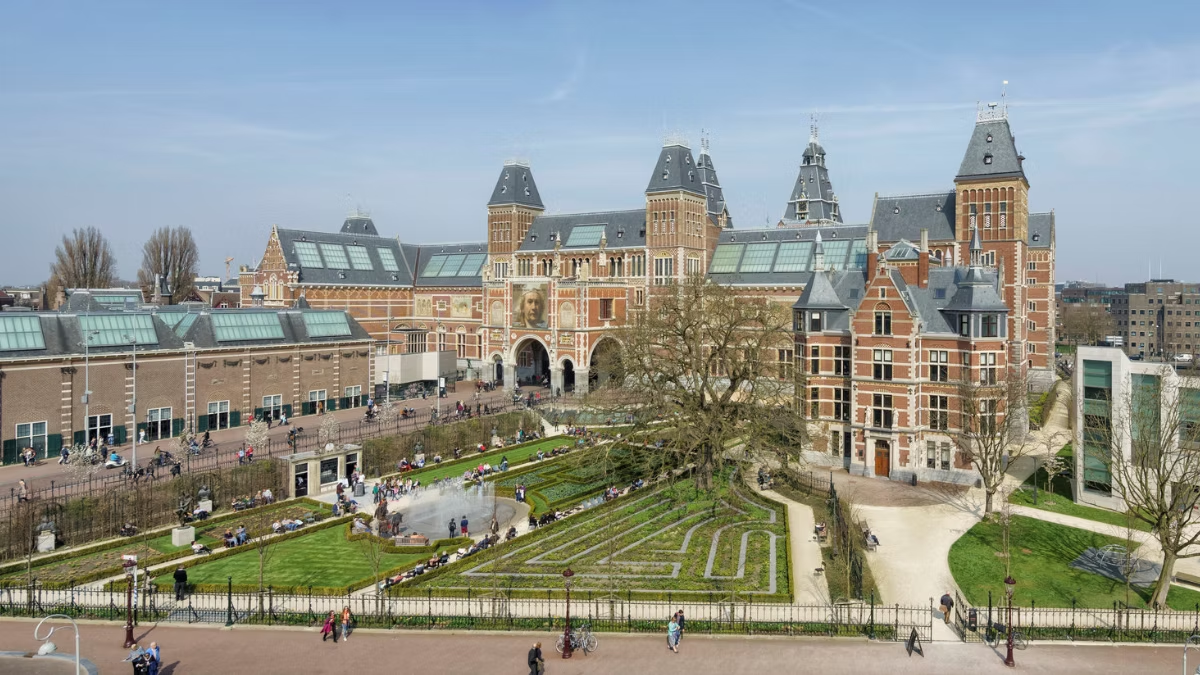
The Rijksmuseum has four floors arranged chronologically. Floor 0 (ground) holds medieval art, the Asian Pavilion, Special Collections, the shop, and The Café. Floor 1 covers 18th and 19th-century art. Floor 2 is the most important — it holds the Gallery of Honour, the Night Watch Room, Petronella Oortman’s dolls’ house, and most of the Dutch Golden Age collection. Floor 3 covers 20th-century art and design. The Cuypers Library is accessible from Room 1.13. A free Floor Plan & Highlights leaflet (blue for English) is available at the Information Desk.
The Rijksmuseum is bigger than most visitors expect — 80 galleries across 4 floors, with two sets of paired courtyards and side wings. Even with a ticket in hand, it’s easy to spend 20 minutes trying to find The Night Watch on your first visit. This guide lays out the floor plan as the museum is actually organized, where the major works live, and the smartest route through the building for visitors with different amounts of time.
The Museum Layout at a Glance
The Rijksmuseum is organized chronologically by floor — enter on Floor 0, take the stairs or lift up. Floor 1 covers 18th–19th century. Floor 2 is the headline floor with the Dutch Golden Age. Floor 3 covers 20th century. Each floor is divided into two squares joined by a central atrium, with a side passage to the Philips Wing (home to RIJKS restaurant and the Picnic Room) and the Asian Pavilion (accessible from Floor 0).
The building’s design by Pierre Cuypers follows two main squares joined in the centre by a glass atrium and a tunnel that runs through the building at ground level. The Gallery of Honour — the museum’s ceremonial heart — runs along the first-floor central axis directly above this tunnel.
A quick orientation principle: the Rijksmuseum’s floor numbering follows the Dutch convention. Floor 0 is the ground floor (entry level), Floor 1 is the floor above, Floor 2 is above that, Floor 3 is the top. The most famous room in the museum — the Night Watch Room — is on Floor 2, not the first floor as some English-language guides confusingly suggest.
Floor 0 (Ground Floor): Entry, Medieval Art, Asian Pavilion
This is where you arrive — tickets scanned, cloakroom deposited, ticket-holder doors entered via The Passage. The atrium, shop, and The Café are all here.
What’s on Floor 0:
- The Atrium — glass-roofed central courtyard where The Café sits
- The Shop — the main museum shop, open 9 AM to 6 PM
- Cloakroom and free lockers — mandatory for bags over A4 size
- Information Desk — pick up the free Floor Plan & Highlights leaflet here (blue = English)
- Medieval art and Early Renaissance (rooms 0.1–0.5) — pre-1600 paintings, religious art, illuminated manuscripts
- The Asian Pavilion — accessed via the passage between rooms 0.5 and 0.6. Chinese bronzes, Japanese screens, Indonesian temple sculpture, and South Asian art. One of Europe’s finest Asian collections.
- The Philips Wing — south wing, accessible from Floor 0 past the Asian Pavilion. Houses RIJKS restaurant, special exhibitions, and the Picnic Room.
- Special Collections — one of the museum’s hidden gems: ship models, weapons, musical instruments, and decorative arts
What to prioritize here: Most visitors skip Floor 0 on the way up and visit it on the way back down if they have energy left. The Asian Pavilion is the main draw and often the least crowded part of the museum.
Floor 1: 18th and 19th Century
Floor 1 covers the period after the Dutch Golden Age — 18th-century French influences, the Napoleonic era, and 19th-century Dutch art.
What’s on Floor 1:
- 18th-century galleries (rooms 1.1–1.8) — French court influences, Delftware, Dutch pastoral
- 19th-century galleries (rooms 1.10–1.18) — Romanticism, the Hague School, early realism
- Room 1.12 — home to Jan Willem Pieneman’s monumental The Battle of Waterloo (1824), one of the largest paintings in the museum at over 5 by 8 metres
- Room 1.13 — the viewing gallery for the Cuypers Library, one of the museum’s most photographed spots
- Room 1.18 — Vincent van Gogh’s Self-Portrait (c. 1887), the museum’s most famous Van Gogh work
- Passage to the Philips Wing — accessible beside the Cuypers Library viewing gallery
What to prioritize here: The Cuypers Library viewing gallery, the Van Gogh self-portrait, and The Battle of Waterloo are the three major stops most visitors take on Floor 1.
Floor 2: The Headline Floor — Dutch Golden Age
This is why most people come. Floor 2 is the 17th-century Dutch Golden Age — the richest concentration of famous paintings in the museum.
What’s on Floor 2:
- The Great Hall (Voorhal) — the ceremonial entry to the Gallery of Honour, with stained glass, mosaic floors, and painted ceilings. Designed by Cuypers to represent the ideals of art, work, and faith.
- The Gallery of Honour (Eregalerij) — a long enfilade of rooms with side alcoves, each dedicated to a major Golden Age master. Running from the Great Hall to the Night Watch Room. Contains: Vermeer’s The Milkmaid, The Little Street, Woman Reading a Letter, Woman with a Water Pitcher; Frans Hals’ The Merry Drinker; works by Jan Steen, Pieter de Hooch, and others.
- The Night Watch Room (room 2.30) — the ceremonial end of the Gallery of Honour, built specifically to house Rembrandt’s The Night Watch (1642). Operation Night Watch — the ongoing restoration — is visible behind glass in this room.
- Room 2.8 — contains Rembrandt’s earlier self-portrait from his youth
- Room 2.20 — Petronella Oortman’s dolls’ house plus two other 17th-century dolls’ houses
- Room 2.22 (and nearby) — Delftware collection, one of the world’s finest
- Rooms 2.1–2.27 — side rooms covering Dutch history (William of Orange, the Treaty of Münster, Nova Zembla expedition), additional Rembrandt works, Avercamp winter landscapes, and the Flemish influence galleries
What to prioritize here: Start at the Great Hall end and walk the length of the Gallery of Honour to The Night Watch. Detour into side rooms as interest dictates. Allow at least 45 minutes to an hour for this floor alone.
See Rijksmuseum in 2 Hours: A Self-Guided Route for a full prioritized list.
Floor 3: 20th Century and Contemporary
Often skipped, Floor 3 covers 20th-century Dutch design, modernism, and contemporary art.
What’s on Floor 3:
- Art Nouveau (room 3.1) — early 20th-century decorative arts
- Rietveld (room 3.2) — Dutch design icon Gerrit Rietveld’s work
- CoBrA and post-war (room 3.3) — Constant, Karel Appel, the Dutch avant-garde
- Yves Saint Laurent Mondrian dress (room 3.4) — a 20th-century response to the De Stijl movement; one of the more surprising items in the collection
- Aircraft gallery — an actual 1917 Fokker single-engine plane suspended in the gallery
What to prioritize here: The Mondrian dress, Rietveld’s furniture, and the suspended aircraft are the memorable stops. Most visitors spend 20–30 minutes here at most.
Where to Find the Most Famous Works
| Painting / Object | Floor | Room |
|---|---|---|
| The Night Watch (Rembrandt) | 2 | Night Watch Room (2.30) |
| The Milkmaid (Vermeer) | 2 | Gallery of Honour |
| The Little Street (Vermeer) | 2 | Gallery of Honour |
| Woman Reading a Letter (Vermeer) | 2 | Gallery of Honour |
| The Jewish Bride (Rembrandt) | 2 | Gallery of Honour |
| The Merry Drinker (Frans Hals) | 2 | Gallery of Honour |
| The Threatened Swan (Jan Asselijn) | 2 | Gallery of Honour |
| Petronella Oortman's Dolls' House | 2 | Room 2.20 |
| Rembrandt's Young Self-Portrait | 2 | Room 2.8 |
| The Battle of Waterloo (Pieneman) | 1 | Room 1.12 |
| Van Gogh Self-Portrait | 1 | Room 1.18 |
| Cuypers Library (viewing gallery) | 1 | Room 1.13 |
| Asian Pavilion | 0 | Passage between 0.5 and 0.6 |
| Dutch aircraft (Fokker) | 3 | Aircraft gallery |
| Yves Saint Laurent Mondrian dress | 3 | Room 3.4 |
| RIJKS restaurant | Philips Wing | Separate Museumplein entrance |
| The Café | 0 | Atrium |
| Picnic Room | Philips Wing | Accessed from Floor 0 |
Suggested Routes Through the Museum
90-minute route (highlights only)
- Enter → Floor 0 → take stairs or lift straight to Floor 2
- Floor 2: Great Hall → Gallery of Honour (Vermeers, Hals) → Night Watch Room
- Floor 2: Dolls’ house (room 2.20) → Rembrandt self-portrait (room 2.8)
- Down to Floor 1 → Cuypers Library viewing gallery (1.13) → Battle of Waterloo (1.12) → Van Gogh self-portrait (1.18)
- Exit via The Café and Shop on Floor 0
2.5-hour route (balanced)
Add to the 90-minute route:
- Asian Pavilion on Floor 0 (30 minutes)
- Floor 3 — Rietveld, Mondrian dress, aircraft (20 minutes)
- Coffee or lunch at The Café (30 minutes)
4-hour route (comprehensive)
Add to the 2.5-hour route:
- All Floor 2 side rooms — additional Rembrandts, Avercamps, Delftware
- Floor 1 18th- and 19th-century galleries in more depth
- Special Collections on Floor 0 (ship models, weapons, musical instruments)
- Gardens in summer
See our dedicated 2-hour self-guided route for a room-by-room itinerary.
How to Get the Official Floor Plan
The museum provides a free Floor Plan & Highlights leaflet at the Information Desk on the ground floor. Two versions:
- Blue cover — English
- Orange cover — Dutch
Illustrated by Dutch artist Jan Rothuizen, the leaflet maps each floor and flags the main highlights. Large-format versions of Rothuizen’s maps also hang at strategic points throughout the building as wayfinding aids.
Download in advance: The floor plan is also available as a PDF on the official rijksmuseum.nl website. Downloading before you arrive saves you the stop at the Information Desk on entry.
The Rijksmuseum app includes an interactive digital floor plan with highlights, search, and audio tours in 10+ languages. It’s free and worth downloading before your visit.
Lifts, Stairs, and Accessibility
- Lifts to every floor are located in both rooms next to the cloakroom on the ground floor
- Main staircase — the monumental Cuypers staircase leads up to the Great Hall on Floor 2 (with an espresso bar at its base)
- Wheelchairs, folding stools, walking sticks — free to borrow from the Information Desk
- Accessible toilets — on every floor
- Baby changing facilities — available on every floor
For full detail on accessibility, see Rijksmuseum Accessibility.
What Most Visitors Get Wrong
Expecting to see The Night Watch immediately. It’s on Floor 2, which means stairs or a lift from your ground-floor entry. From the entrance, look for signs pointing up to “Gallery of Honour” or “Eregalerij.”
Getting confused by the numbering. English-language travel sites often describe “the first floor” without specifying whose convention. The museum’s own numbering puts the Gallery of Honour on Floor 2 (two floors above entry), not Floor 1.
Missing the Asian Pavilion. It’s a separate building connected by a passage from Floor 0 — easy to walk straight past if you’re rushing up to see Rembrandt. One of the best and least crowded parts of the museum.
Trying to see everything in one sweep. The building is two squares joined by a central axis, but the side rooms don’t follow a straightforward linear sequence. Back-and-forth movement is normal; plan for it.
Frequently Asked Questions
Which floor is The Night Watch on at the Rijksmuseum?
Floor 2, in the Night Watch Room at the end of the Gallery of Honour. Take the stairs or lift from the ground-floor entry up two flights; follow signs for the Gallery of Honour.
Where is the Gallery of Honour in the Rijksmuseum?
Floor 2, in the central axis of the museum directly above the entrance tunnel. You enter it through the Great Hall at one end, walk its length, and end at the Night Watch Room.
How many floors does the Rijksmuseum have?
Four floors — Floor 0 (ground/entry), Floor 1 (18th–19th century), Floor 2 (Dutch Golden Age), and Floor 3 (20th century). Plus the Philips Wing and Asian Pavilion as connected side buildings.
Can I get a paper map at the Rijksmuseum?
Yes. A free Floor Plan & Highlights leaflet is available at the Information Desk on the ground floor. The English version has a blue cover; the Dutch version is orange.
Where is the Cuypers Library?
Room 1.13 on Floor 1. It’s a viewing gallery — the library itself is reserved for researchers, but the galleried multi-storey interior is visible from the platform.
Is there a digital floor plan or app for the Rijksmuseum?
Yes. The free Rijksmuseum app includes an interactive floor plan, audio tours in 10+ languages, and a search for specific artworks. Download before you arrive.
How is the Rijksmuseum organized?
Chronologically by floor. Floor 0 covers medieval to early Renaissance plus Asian art. Floor 1 is 18th–19th century. Floor 2 is the 17th-century Dutch Golden Age (the headline collection). Floor 3 is the 20th century.
