
Petronella Oortman's Dolls' House (2026): Rijksmuseum Visitor's Guide
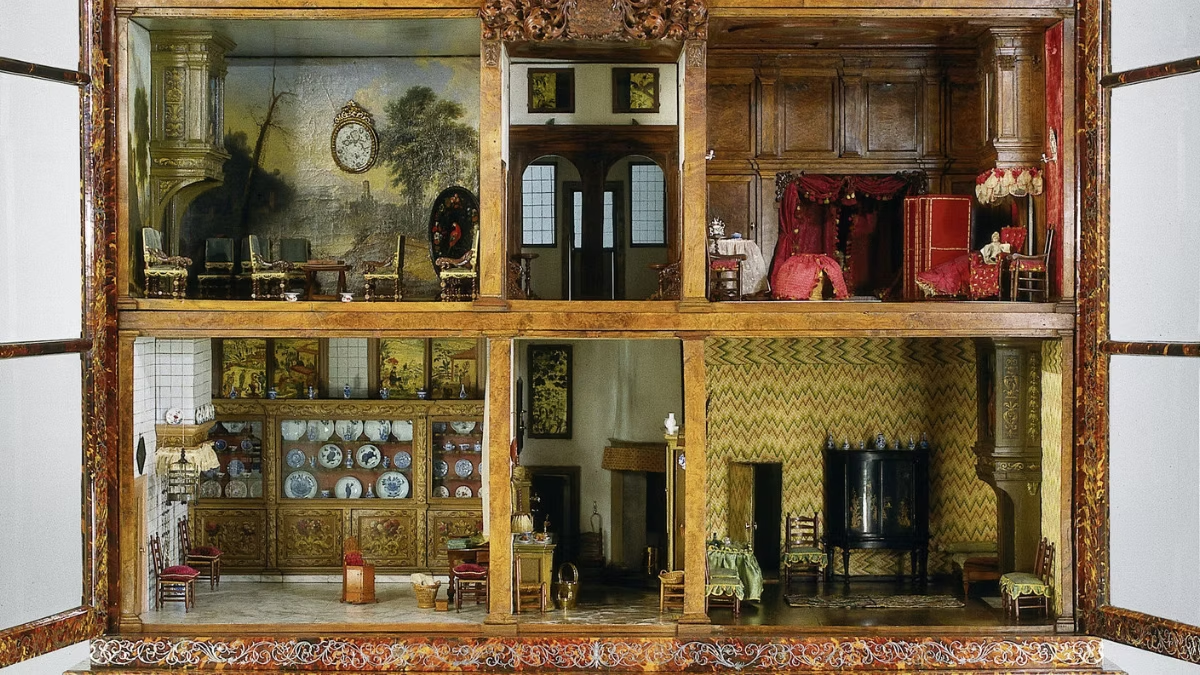
Petronella Oortman’s Dolls’ House is a three-metre-tall cabinet commissioned by a wealthy Amsterdam merchant’s wife Petronella Oortman (1656-1716) between 1686 and 1710 as a scaled replica of a grand Amsterdam canal house. It cost approximately 20,000-30,000 guilders to commission — roughly the price of a real canal house in 17th-century Amsterdam. Every miniature object inside is custom-made by specialist craftsmen: real porcelain, silver, silk, and wood, scaled to 1:9. On display in Room 2.20 on Floor 2 of the Rijksmuseum, near the Gallery of Honour. One of the museum’s most beloved objects — particularly with children and visitors interested in 17th-century domestic life. Inspired Jessie Burton’s 2014 novel The Miniaturist and the BBC television adaptation. Free to see with standard entry.
Most visitors walk through the Gallery of Honour to see The Night Watch and the Vermeers, and in doing so walk right past one of the Rijksmuseum’s most extraordinary objects. Petronella Oortman’s Dolls’ House isn’t a painting but a three-dimensional time capsule of 17th-century wealth and domestic life, created at staggering expense by a woman whose name most visitors don’t know. This guide covers exactly what it is, what to look for, its extraordinary history, and why visitors consistently rate it among the museum’s most memorable experiences.
What Is Petronella Oortman’s Dolls’ House?
It’s a scaled-down replica of a 17th-century Amsterdam canal house, housed in an ornate wooden cabinet approximately 2.55 metres tall by 1.90 metres wide. Unlike modern dolls’ houses made for children, this was an adult collectible and status symbol — a serious art object. Every miniature inside was custom-commissioned from specialist craftsmen: real porcelain from China and Delft, real silver tableware, real silk curtains, scaled furniture. The cabinet has nine rooms across three floors, each reflecting the layout and décor of a genuine upper-class Amsterdam home. Petronella Oortman commissioned it over more than two decades (c. 1686-1710), spending between 20,000 and 30,000 guilders — enough to buy a full-size canal house. It’s not the only such cabinet (several similar survive) but it’s widely considered the finest.
Key facts at a glance
| Fact | Detail |
|---|---|
| Name | Dolls' House (Poppenhuis) of Petronella Oortman |
| Owner | Petronella Oortman (1656-1716), wealthy Amsterdam silk merchant's wife |
| Created | Between c. 1686 and 1710 |
| Cabinet dimensions | ~2.55 m tall × 1.90 m wide |
| Number of rooms | 9 across 3 floors |
| Scale | Approximately 1:9 |
| Original cost | 20,000-30,000 guilders (~€1-2 million in modern money) |
| Location | Room 2.20, Floor 2, Rijksmuseum |
| Access | Included with standard Rijksmuseum entry ticket |
| Restoration | Extensive conservation in 2013 (during museum renovation) |
Where to Find It
The Dolls’ House is in Room 2.20 on Floor 2 of the Rijksmuseum, just off the Gallery of Honour. From the main atrium, take the staircase or lift up two floors to Floor 2. Enter the Gallery of Honour via the Great Hall. Room 2.20 is accessed via a small corridor branching off the Gallery of Honour — typically the second or third branching corridor on your right as you walk toward the Night Watch Room. The dolls’ house is the central object in the room, displayed behind glass with additional interpretive displays around it.
Navigation step by step
- Enter the museum on Floor 0 (main atrium)
- Take the staircase or lift up two floors to Floor 2
- Enter the Great Hall (Voorhal) — the stained-glass entryway
- Walk into the Gallery of Honour
- Look for the corridors branching off to the right — Room 2.20 is one of these
- The dolls’ house sits in the centre of the room, behind a glass display case with interpretive panels around it
See Rijksmuseum Floor Plan & Map.
Room 2.20 layout
The room is moderately sized and designed around the dolls’ house as its centrepiece. Other 17th-century decorative objects and some paintings relating to Dutch domestic life are also displayed here. It’s typically less crowded than the Gallery of Honour — many visitors don’t know it’s there.
Who Was Petronella Oortman?
Petronella Oortman was born in 1656 into a wealthy Amsterdam merchant family. In 1686 she married Johannes Brandt, a prosperous silk merchant, and commissioned the dolls’ house over the next two-and-a-half decades — completing it around 1710. She outlived her husband and died in 1716. The dolls’ house was her personal commission, not her husband’s, and she spent a fortune on it. In her lifetime it was displayed in her home as a serious art object and status symbol. She had three daughters; none appear to have continued the collection.
What we know about her
Historical records about Oortman are limited but suggestive:
- Born 1656 in Amsterdam, into a patrician family
- Married Johannes Brandt in 1686 — a 30-year marriage ending at his death
- Had three daughters — Cornelia, Hendrika, and Agnes — and a son who died in infancy
- Attended St Nicholas Church in Amsterdam
- Commissioned the dolls’ house over 24 years — a continuous project
- Left extensive wealth in her 1716 will — including the dolls’ house, which passed through her heirs
What we don’t know: why she commissioned it. Dolls’ houses for wealthy adults were a recognisable Dutch status symbol in the late 17th century — Dutch collectors’ houses often functioned as miniature recreations of the owner’s own home. Oortman’s may be a detailed replica of her Amsterdam residence.
The Rooms Inside
The cabinet has nine rooms across three floors, representing the typical layout of an upper-class Amsterdam canal house.
Ground floor
- The tapestry room — main reception room, with tiny tapestries, a fireplace, and expensive furniture
- The lying-in room — a room where a new mother would receive visitors after childbirth; a specifically Dutch tradition
- The kitchen — staffed by miniature servants, with real working tools (tiny pots, knives, ceramics)
First floor
- The best bedroom — silk-curtained bed, dressing table with miniature cosmetics
- The art cabinet room — a display of miniature paintings commissioned from real artists
- The library — miniature bound books, a writing desk
Second floor
- The linen room — shelves of miniature folded linens
- The nursery — with miniature cradles and children’s items
- The servant’s room or lumber room
The miniature objects
Every object inside was commissioned at full craft quality:
- Real porcelain — from China, the Dutch East India Company, and Delft
- Real silver — miniature tableware and decorative items by Amsterdam silversmiths
- Real silk curtains — woven to scale
- Real miniature paintings — commissioned from working artists of the era
- Real leather bound books — many with text inside
- Working tools — miniature knives, pots, brooms made by specialist craftsmen
The time and cost of commissioning so many custom miniature objects is what drove the project’s extraordinary expense.
What to Look For
When you’re standing in front of the cabinet, spend time on these specific details:
The tapestry room
- Look at the tiny tapestries on the walls — painstakingly woven at 1:9 scale
- The fireplace has real logs (scaled) and the working tools a real Dutch home would have
- The ceiling painting above the fireplace is a real miniature oil painting by an identified artist
The kitchen
- Open drawers aren’t visible but the miniature kitchen equipment is astonishingly detailed — copper pots, wooden spoons, ceramic storage jars
- The staff arrangement shows how 17th-century Dutch households functioned
- Look for the pump and water management details
The art cabinet
- This is the room that most rewards close looking
- The miniature paintings on the walls are real small-scale oil paintings commissioned for the cabinet — this isn’t decorative wallpaper, these are genuine art objects
- Identifying artists have been traced for some; others remain anonymous
The lying-in room
- A specifically Dutch 17th-century tradition rooms designated for a new mother
- Has a birthing chair and miniature baby items
- Reflects how wealthy Dutch families celebrated childbirth as a public event
The Cost — In Context
Historical records suggest the dolls’ house cost between 20,000 and 30,000 guilders over its 24 years of commissioning. To understand that figure:
- A typical Amsterdam canal house in 1700: 20,000-40,000 guilders
- The Night Watch by Rembrandt (1642): approximately 1,600 guilders
- Vermeer’s The Milkmaid (c. 1658): approximately 150-200 guilders for the original commission
- A skilled craftsman’s annual wage in 1700: roughly 250-400 guilders
Oortman spent the equivalent of a real canal house — and more than 10 times the purchase price of Rembrandt’s largest and most prestigious painting — on a miniature replica of a canal house.
Why?
The dolls’ house wasn’t a toy. It was: – A status object — demonstrating wealth through rare, custom craft – A collection — each miniature was a commissioned artwork in its own right – A scholarly and aesthetic pursuit — 17th-century Dutch women of her class often engaged in collecting as a form of intellectual engagement – A private museum — visible to select visitors, expressing Oortman’s personal identity and taste
Petronella Dunoys: The Other Famous Dolls’ House
There’s an important distinction some visitors miss. The Rijksmuseum has two 17th/18th-century dolls’ houses on display:
- Petronella Oortman’s Dolls’ House — the one described in this guide, in Room 2.20
- Petronella Dunoys’ Dolls’ House — a slightly earlier cabinet (c. 1676), also in the Rijksmuseum collection, sometimes displayed in the same area
Both are masterpieces but Oortman’s is the more famous — partly because of the novel The Miniaturist (see below) and partly because of its larger scale and greater survival of original interiors.
The Miniaturist: Novel and BBC Adaptation
Petronella Oortman’s dolls’ house directly inspired Jessie Burton’s 2014 novel The Miniaturist — a bestselling historical thriller set in 1686 Amsterdam, focused on a young woman named Petronella “Nella” Brandt (clearly based on Oortman) who receives a miniature cabinet as a wedding gift and begins receiving mysterious miniature figures that seem to predict her family’s future.
The novel was adapted as a BBC television series in 2017, starring Anya Taylor-Joy as Nella. The series was filmed partly in Amsterdam with extensive research into 17th-century Dutch domestic life.
Literary/fictional liberties: Burton fictionalised almost everything about Oortman’s life. The real Oortman’s story is less dramatic than the novel suggests — she had a long, apparently stable marriage and lived quietly. Burton’s focus on secrets, miniaturists, and supernatural elements is invented. But the dolls’ house itself, its extraordinary detail and cost, is accurate.
Many visitors to the Rijksmuseum come specifically because of the novel. If you’ve read the book or watched the BBC series, seeing the actual dolls’ house is a profound experience — you understand the scale and obsessive detail that inspired Burton.
Photography
Handheld photography without flash is permitted. The dolls’ house is behind glass, so photos may have reflections depending on angle. Try slight off-axis angles to minimise reflection. The Rijksstudio platform offers high-resolution official photographs at rijksmuseum.nl for free download — better than most handheld shots of the cabinet can achieve.
See Rijksmuseum Photography Rules.
Why the Dolls’ House Matters
Beyond its visual extraordinariness, the cabinet is important for several reasons:
As social history
It’s the most detailed surviving record of what an upper-class 17th-century Amsterdam home looked like — including rooms, objects, and living arrangements that have left no other physical trace. Historians studying Dutch Golden Age domestic life treat the cabinet as a primary source.
As women’s history
Commissioned by a woman, filled with women’s domestic concerns, it documents a side of 17th-century Dutch life that’s underrepresented in the grand civic portraits that dominate Golden Age painting. Paintings of the era were largely commissioned by men; Oortman’s cabinet gives a different perspective.
As craft history
The specialist craftsmen who made the miniatures represent a level of precision and care that’s largely vanished. Re-creating the cabinet today would cost tens of millions; many of the specialist techniques no longer exist.
As conservation showcase
The 2013 Rijksmuseum renovation included extensive conservation of the cabinet — revealing damage, cleaning and repairing items, documenting each miniature object. The conservation data is one of the largest recordsets of 17th-century Dutch material culture.
Visitor Tips
- The room is quiet — Room 2.20 is typically less crowded than the Gallery of Honour, making it easier to get close to the cabinet
- Bring reading glasses or zoom — the miniatures reward very close looking
- Kids love it — genuinely one of the museum’s most child-friendly experiences. See Visiting the Rijksmuseum with Kids.
- Plan 15-20 minutes — enough time to walk around the cabinet and study each room
- The interpretive panels in the room explain individual miniatures and their craftsmen
Frequently Asked Questions
Where is Petronella Oortman’s dolls’ house at the Rijksmuseum?
Room 2.20 on Floor 2, accessed via a corridor branching off the Gallery of Honour. From the main atrium, take the stairs or lift up two floors, enter the Great Hall and then the Gallery of Honour, and look for the branching corridors on your right.
Is Petronella Oortman’s dolls’ house the inspiration for The Miniaturist novel?
Yes. Jessie Burton’s 2014 novel The Miniaturist is directly inspired by this cabinet. Burton fictionalised Oortman’s life substantially, but the dolls’ house itself — its scale, cost, and extraordinary detail — is accurate. The BBC television adaptation in 2017 filmed partly in Amsterdam.
How much did Petronella Oortman’s dolls’ house cost?
Approximately 20,000-30,000 guilders over 24 years of commissioning — equivalent to the price of a real Amsterdam canal house at the time, and more than 10 times what Rembrandt’s The Night Watch originally cost.
How big is the dolls’ house at the Rijksmuseum?
The cabinet is approximately 2.55 metres tall by 1.90 metres wide. Each of the nine interior rooms is roughly 25-40 cm on a side.
When was Petronella Oortman’s dolls’ house made?
Commissioned between c. 1686 and 1710, over roughly 24 years of ongoing commissioning of miniatures from specialist craftsmen. Different rooms and objects were added at different times.
Are the miniatures inside made of real materials?
Yes. Real porcelain, real silver, real silk, real leather. The objects weren’t mass-produced toys but custom-commissioned scaled-down versions of real domestic objects. Many of the miniature paintings on the cabinet walls are real small-scale oil paintings by identified 17th-century Dutch artists.
Can I see inside every room of the dolls’ house?
The cabinet is open-fronted for viewing — all nine rooms are visible through the display glass. You cannot open drawers or access interior details that aren’t visible from the exterior.
Is the dolls’ house original or has it been restored?
Extensively restored in 2013 during the Rijksmuseum’s major renovation. The cabinet itself and most interior objects are original 17th/18th-century. A few items have been reconstructed where originals were damaged beyond repair, with clear documentation.
Are there other dolls’ houses at the Rijksmuseum?
Yes. Petronella Dunoys’ Dolls’ House (c. 1676) is also on display — an earlier, smaller cabinet. Several smaller 18th-century miniatures and models are also part of the collection. Oortman’s is the most famous.
Is the dolls’ house good for children?
Yes — often the single most memorable object in the museum for young visitors. The miniatures are visually engaging and the scale is relatable. Consider combining with the museum’s Family Quest scavenger hunt (€2.50 for ages 7+). See Visiting the Rijksmuseum with Kids.
Can I photograph the dolls’ house?
Yes — handheld photography without flash is permitted. Try slight angles to reduce glass reflections. For higher-quality images, the Rijksmuseum’s Rijksstudio platform offers free downloadable high-resolution official photographs.
