
Dutch Golden Age Painting (2026): Complete Beginner's Guide & Rijksmuseum Examples
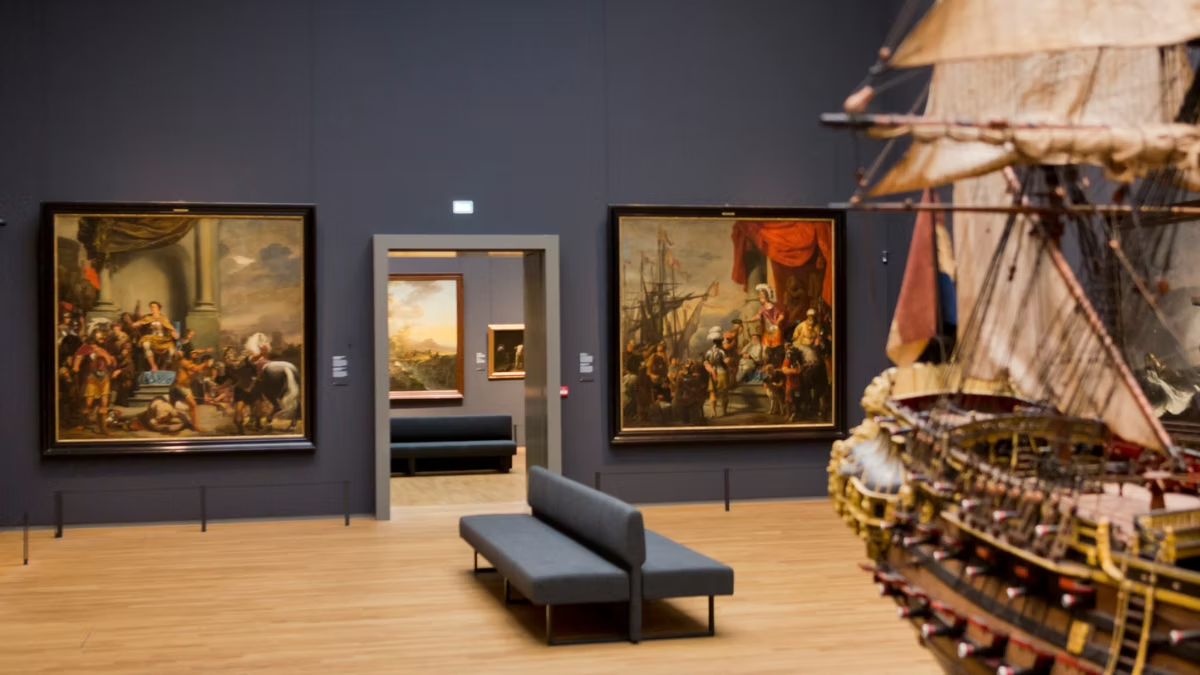
The Dutch Golden Age was an extraordinary period of Dutch art from roughly 1600 to 1700, during which the newly independent Dutch Republic produced more paintings per capita than any other society in history — an estimated 5-10 million paintings made for a population of just 2 million. The era’s artistic leaders were Rembrandt van Rijn (1606-1669), Johannes Vermeer (1632-1675), and Frans Hals (c. 1582-1666). Genres that flourished included genre painting (everyday scenes), portraits, landscapes, still lifes, seascapes, and church interiors. The Rijksmuseum holds the world’s greatest collection of Dutch Golden Age painting — concentrated in the Gallery of Honour on Floor 2. This beginner’s guide covers what to know before visiting: the era, the artists, the genres, and how to read the paintings.
If you’re coming to the Rijksmuseum and Dutch Golden Age painting isn’t your specialty, a bit of context transforms the visit. Understanding why the Dutch painted so much, what they painted, and how to look at the works makes walking through the Gallery of Honour an entirely different experience. This guide covers what you need to know — not as an art-history crash course, but as practical framing for your visit.
What Was the Dutch Golden Age?
The Dutch Golden Age was the roughly 100-year period (1600-1700) when the newly independent Dutch Republic became Europe’s wealthiest and most culturally productive nation per capita. Following independence from Spain (officially recognized in 1648), the Dutch built a trading empire spanning the globe via the Dutch East India Company (VOC), creating unprecedented urban wealth in cities like Amsterdam, Haarlem, Delft, and Leiden. This wealth flowed into commissioning and buying paintings at rates unmatched anywhere else in Europe — ordinary merchants and shopkeepers bought art in volume, not just nobles and clergy. Estimated 5-10 million paintings were made during the era for a population of roughly 2 million people.
The historical context
Three things made the Dutch Golden Age possible:
1. Political independence. The Dutch Republic emerged from an 80-year war against Spanish Habsburg rule. The 1648 Peace of Westphalia officially recognized Dutch independence. The new country was a federal republic — unusual in a Europe of monarchies — with substantial civil liberties, religious tolerance (relatively), and strong middle-class property rights.
2. Economic explosion. The Dutch East India Company (VOC), founded in 1602, became the world’s first joint-stock corporation and built a global trading empire. Amsterdam became the financial capital of Europe. Merchants grew enormously wealthy.
3. Protestant art market. Unlike Catholic Europe where the Church commissioned most art, the Dutch were largely Protestant — and Calvinist Protestantism discouraged religious imagery. This redirected artistic production toward non-religious subjects: portraits, landscapes, still lifes, genre scenes. Dutch painters had to invent new markets and new genres.
The result: a country where ordinary people (not just kings and cardinals) bought paintings in large numbers, creating extraordinary demand for art.
Why the era ended
The Dutch Golden Age declined during the last third of the 17th century. Key factors:
- The 1672 “Rampjaar” (Disaster Year) — France, England, and two German states attacked the Republic simultaneously
- War expenses and trade disruptions cratered the art market
- Competition from France in art, manufacturing, and cultural influence
- Generational change — Rembrandt died 1669, Vermeer died 1675, Hals died 1666
By 1700, Dutch artistic production had normalised to European patterns. The exceptional concentration of wealth and artistic output had passed.
The Three Giants
Rembrandt van Rijn (1606-1669)
Where he worked: Leiden (until 1631), then Amsterdam
What he painted: Portraits, biblical and historical scenes, landscapes, self-portraits — Rembrandt’s range is wider than any other Dutch Golden Age painter
Why he matters: Widely considered the greatest Dutch painter and one of the supreme painters in Western art history. His emotional directness, his handling of light, and his late thick-impasto technique were all genuinely original — centuries ahead of his time.
At the Rijksmuseum: Approximately 22 paintings on display, including The Night Watch, The Jewish Bride, The Syndics, and multiple self-portraits. See Rembrandt at the Rijksmuseum: Every Painting.
Key traits to look for: – Dramatic light — often a single strong light source with deep shadows – Emotional intensity — his subjects feel psychologically present – Thick paint in late works — impasto you can physically see – Self-portraits — Rembrandt painted 80+ self-portraits across his career, tracing his own aging
Johannes Vermeer (1632-1675)
Where he worked: Delft (his entire life)
What he painted: Quiet interior scenes with women at domestic tasks, two outdoor views of Delft, a few early history paintings
Why he matters: Vermeer’s handling of light, colour, and atmosphere is unmatched. Only 34 of his paintings survive, making each one globally significant.
At the Rijksmuseum: Four paintings — The Milkmaid, The Little Street, Woman Reading a Letter, and Woman with a Water Pitcher (on long-term loan from the Met NY). See Vermeer at the Rijksmuseum.
Key traits to look for: – Window light from the left — his signature device – Quiet, private moments — no action, no drama – Small scale — most Vermeers are under 60 cm – Expensive pigments — particularly natural ultramarine (from Afghanistan lapis) in vivid blues – Pointillé dots — tiny highlights painted as beads of light
Frans Hals (c. 1582/83-1666)
Where he worked: Haarlem (his entire career)
What he painted: Portraits — individuals, couples, large group portraits of civic guards and regents
Why he matters: Hals’ loose, visible brushwork was 200 years ahead of its time. When rediscovered in the 19th century, he directly influenced Manet, the Impressionists, Sargent, and modern painting.
At the Rijksmuseum: About 10 paintings including The Merry Drinker and Portrait of a Young Couple. See Dutch Golden Age Painting: A Beginner's Guide.
Key traits to look for: – Visible brushstrokes — Hals left his brush marks evident – Rapid handling — the confidence of single-session painting – Psychological presence — his sitters feel like specific individuals – Humour — Hals caught genuine laughter, rare in 17th-century portraiture
The Major Genres
The Dutch Golden Age invented or refined several painting genres. Understanding them helps you navigate the Gallery of Honour.
1. Genre painting (scenes of everyday life)
The dominant Dutch specialty. Shows ordinary people doing ordinary things — pouring milk, playing music, reading letters, celebrating holidays. The Milkmaid by Vermeer is the textbook example.
Key Rijksmuseum examples: – Vermeer’s Milkmaid, Woman Reading a Letter, Woman with a Water Pitcher – Jan Steen’s The Feast of St Nicholas – Pieter de Hooch’s interior scenes – Gabriel Metsu, Gerard ter Borch — smaller genre paintings
What to look for: – Small human dramas in domestic settings – Moral commentary often embedded in everyday scenes (Dutch genre paintings frequently have messages about virtue, excess, temperance) – Precision of material detail — fabric textures, food, objects
2. Portraiture
Dutch wealth meant constant portrait commissions. Styles ranged from formal institutional (civic guards, regents) to intimate personal (couples, individuals, children).
Key Rijksmuseum examples: – Rembrandt’s self-portraits – Frans Hals’ Merry Drinker and Portrait of a Young Couple – The Syndics (Rembrandt group portrait) – The Night Watch (Rembrandt civic guard portrait) – Marten Soolmans and Oopjen Coppit (Rembrandt marriage portraits)
What to look for: – Distinctive individual personalities (Dutch portraits aimed for specificity, not generic “nobleman”) – Elaborate collars, sleeves, lace — a signal of wealth and status – Group portraits — the Rijksmuseum specialty, where Hals and Rembrandt excelled
3. Landscape
Dutch landscape painting was largely a new invention. The flat Dutch countryside, the sky, the water, the windmills — these became serious artistic subjects for the first time.
Key Rijksmuseum examples: – Jacob van Ruisdael’s The Windmill at Wijk bij Duurstede – Hendrick Avercamp’s winter landscapes – Albert Cuyp’s pastoral scenes – Salomon van Ruysdael’s river landscapes
What to look for: – The sky — often takes up two-thirds of the canvas. Ruisdael treated weather as a genuine subject. – Atmospheric effects — morning mist, afternoon light, approaching storms – Social detail — individual figures going about rural life
4. Still life
The Dutch pioneered still life as a major genre. Paintings of flowers, food, tableware, scientific instruments — often loaded with symbolic meaning about vanity, time, and mortality.
Key Rijksmuseum examples: – Willem Kalf’s sumptuous tabletop still lifes – Pieter Claesz’s “breakfast pieces” – Willem Claesz Heda’s similar compositions – Jan Davidsz de Heem’s floral still lifes
What to look for: – Vanitas symbolism — skulls, hourglasses, cut flowers all signal mortality – Exotic objects — Chinese porcelain, Turkish carpets, tropical fruit all signal Dutch trading reach – Texture rendering — Dutch still life painters were obsessive about how silver, glass, velvet, and lemon peel look
5. Seascapes
Dutch maritime trade made seascapes a national specialty. Ships, harbours, storms, battles at sea.
Key Rijksmuseum examples: – Willem van de Velde the Younger — detailed ship portraits – Ludolf Bakhuizen — dramatic storm scenes – Simon de Vlieger — atmospheric coastal views
6. Church interiors
A surprisingly popular genre — painted depictions of Protestant church interiors, often nearly empty, emphasising light and architectural space.
Key Rijksmuseum examples: – Emanuel de Witte and Pieter Saenredam — the two greatest specialists
What to look for: – Whitewashed walls (Protestant churches stripped of Catholic imagery) – Complex perspective — these were technical exercises as well as aesthetic subjects – A single small figure — for scale and atmosphere
7. Animal painting
Dutch painters treated animals with unusual seriousness. Paulus Potter’s cattle, Melchior d’Hondecoeter’s exotic birds, and Jan Asselijn’s famous Threatened Swan.
Key Rijksmuseum examples: – Jan Asselijn’s The Threatened Swan — the most famous Dutch animal painting – Melchior d’Hondecoeter’s exotic bird compositions – Paulus Potter’s cattle (at the Mauritshuis primarily; some at the Rijksmuseum)
How to “Read” a Dutch Golden Age Painting
Dutch paintings often contain more than is immediately obvious. A few habits to develop:
Look for embedded symbolism
Many genre paintings — apparently innocent domestic scenes — contain moral commentary. Signs to watch for:
- Smoking (seen in Jan Steen): a symbol of wasted time
- Broken objects: domestic disorder
- Skulls, hourglasses, burning candles: vanitas (mortality)
- Cupid figures: love (or its dangers)
- Animals: each has symbolic meaning — a dog typically meant fidelity, a parrot often signalled exoticism
- Mirrors: vanity or revelation
- Dressed up children: miniature adults, sometimes moralistic
Look for wealth signals
Dutch paintings frequently display wealth directly:
- Chinese porcelain — recently imported from Asia
- Turkish or Persian rugs — on tables, not floors (too expensive for floors)
- Lemons and tropical fruit — expensive imports
- Elaborate lace — technical and material luxury
- Tulips — at the peak of the tulip mania (1630s-40s), a single bulb could cost a house
Look for specifically Dutch details
- Delft tiles on walls or floors
- Specific architectural details — the crow-stepped gables, the canal-house profiles
- Regional dress — provincial costumes differed from urban fashion
- Religious indicators — bibles, psalm books, church references
Don’t skip the small figures
In landscapes and city views, the tiny figures going about daily life often carry as much information as the main subject. Avercamp’s winter skaters, Vermeer’s doorway neighbours, Steen’s misbehaving children — all reward close viewing.
Why the Rijksmuseum Is the Best Place to Understand Dutch Golden Age
Several reasons the Rijksmuseum is the pre-eminent Dutch Golden Age collection:
Comprehensive coverage
The Rijksmuseum covers every major Dutch Golden Age genre with strong examples: portraits, genre, landscape, still life, seascape, church interior, animal painting, and maritime.
The big three together
Rembrandt, Vermeer, and Hals are all represented in serious depth — Rembrandt at 22 paintings, Vermeer at 4 (rare concentration), Hals at ~10. Few museums match this breadth.
Integrated with Dutch history
The Rijksmuseum shows paintings alongside the society that produced them — the dolls’ house shows domestic life, the maritime paintings relate to the VOC collections, the civic guard portraits relate to the militia culture.
Scholar-level scholarship
The Rijksmuseum Research Library (Cuypers Library) is one of the world’s great art-history libraries, and the museum’s curatorial research sets the standards for Dutch Golden Age studies. The interpretation you encounter in galleries reflects the current state of scholarship.
Where to Continue Learning
After the Rijksmuseum, if you want to go deeper:
Other Netherlands museums
- Mauritshuis, The Hague — 3 Vermeers including Girl with a Pearl Earring, plus strong Rembrandt and other Dutch Golden Age
- Frans Hals Museum, Haarlem — the world’s best Hals collection; worth a day trip
- Kröller-Müller Museum — Van Gogh plus older Dutch painting
- Stedelijk Museum — modern art, contrasts well with the Rijksmuseum
International collections
- National Gallery, London — substantial Dutch Golden Age
- Metropolitan Museum of Art, New York — 5 Vermeers, many Rembrandts and Hals
- National Gallery of Art, Washington DC — another 4 Vermeers
- Louvre, Paris — substantial Rembrandt collection (including joint-custody Marten Soolmans and Oopjen Coppit)
Reading
For accessible further reading on the Dutch Golden Age:
- Simon Schama, The Embarrassment of Riches (1987) — the standard cultural history
- Svetlana Alpers, The Art of Describing (1983) — how Dutch paintings approach visual truth
- Any major Rembrandt or Vermeer biography — gives you the context for one artist deeply
Frequently Asked Questions
What is Dutch Golden Age painting?
Dutch painting from roughly 1600 to 1700, during the century when the newly independent Dutch Republic became Europe’s wealthiest nation per capita. The era produced an estimated 5-10 million paintings for a population of just 2 million — the highest rate of artistic production in any society to that date.
Who are the most famous Dutch Golden Age painters?
Rembrandt van Rijn (1606-1669), Johannes Vermeer (1632-1675), and Frans Hals (c. 1582-1666) are the three most famous. Other major painters include Jan Steen, Jacob van Ruisdael, Pieter de Hooch, Willem Kalf, Hendrick Avercamp, and Jan Asselijn.
What kind of paintings did the Dutch Golden Age produce?
Genre paintings (everyday life scenes), portraits, landscapes, still lifes, seascapes, church interiors, and animal paintings. Unlike Catholic Europe where religious paintings dominated, the Protestant Dutch largely avoided biblical and saints subjects in favour of secular genres.
Why is the Dutch Golden Age important?
Three reasons: (1) the volume of production was unprecedented — more paintings per capita than any society before; (2) the era invented or refined many genres that became standard in Western art (landscape, still life, genre painting); (3) it produced some of the greatest individual masterpieces in art history — Vermeer’s Milkmaid, Rembrandt’s Night Watch, and others.
How did the Dutch Golden Age end?
Around 1672 when France, England, and two German states attacked the Dutch Republic simultaneously (“Rampjaar” or Disaster Year). War disrupted the economy and the art market. By 1700, Dutch artistic production had normalised to European patterns, and the exceptional concentration of the Golden Age was over.
Where can I see the best Dutch Golden Age paintings?
The Rijksmuseum in Amsterdam has the best single collection — the world’s greatest Dutch Golden Age concentration, with strong Rembrandt, Vermeer, and Hals holdings plus comprehensive genre coverage. The Mauritshuis in The Hague is a close second.
Why did the Dutch paint so much more than other countries?
Combination of factors: economic wealth from Dutch East India Company trade, a large Protestant middle class who bought paintings (unusual in Europe where art was typically church or aristocracy commissioned), a large network of skilled painters training in specialised workshops, and relatively affordable paint materials compared to other European countries.
What is genre painting?
Scenes of everyday life — people doing ordinary things in ordinary settings. A Dutch specialty. The Milkmaid by Vermeer is the textbook example — a servant pouring milk in a plain kitchen. Genre paintings were the bulk of Dutch Golden Age production.
Is Dutch Golden Age painting the same as Baroque?
Related but distinct. Baroque was the dominant pan-European style of the 17th century (Caravaggio, Rubens, Bernini). Dutch Golden Age painting overlaps in time with Baroque but had different characteristics — more focused on secular genres, less dramatic in emotional register, more concerned with ordinary life. Some scholars consider Dutch Golden Age a variant of Northern Baroque; others treat it as a distinct tradition.
What should I look for when viewing Dutch Golden Age paintings?
Three habits help: (1) look for embedded symbolism (skulls, candles, cupids all carried meanings); (2) notice wealth signals (Chinese porcelain, Turkish rugs, tropical fruit); (3) don’t skip the small figures in landscapes and group scenes — they often carry as much information as the main subject.
Is the Rijksmuseum’s collection free to see?
Yes — all Dutch Golden Age paintings at the Rijksmuseum are included with a standard €25 adult entry ticket (free for under-18s). No additional booking or fees required.
Can I download Dutch Golden Age images for free?
Yes. The Rijksmuseum’s Rijksstudio platform (rijksmuseum.nl/en/rijksstudio) offers every painting in the collection in ultra-high-resolution free download, with no copyright restrictions on historical works. This is one of the most generous open-access art programmes in the world.
