
Rembrandt Self-Portraits at the Rijksmuseum (2026): All Paintings Guide
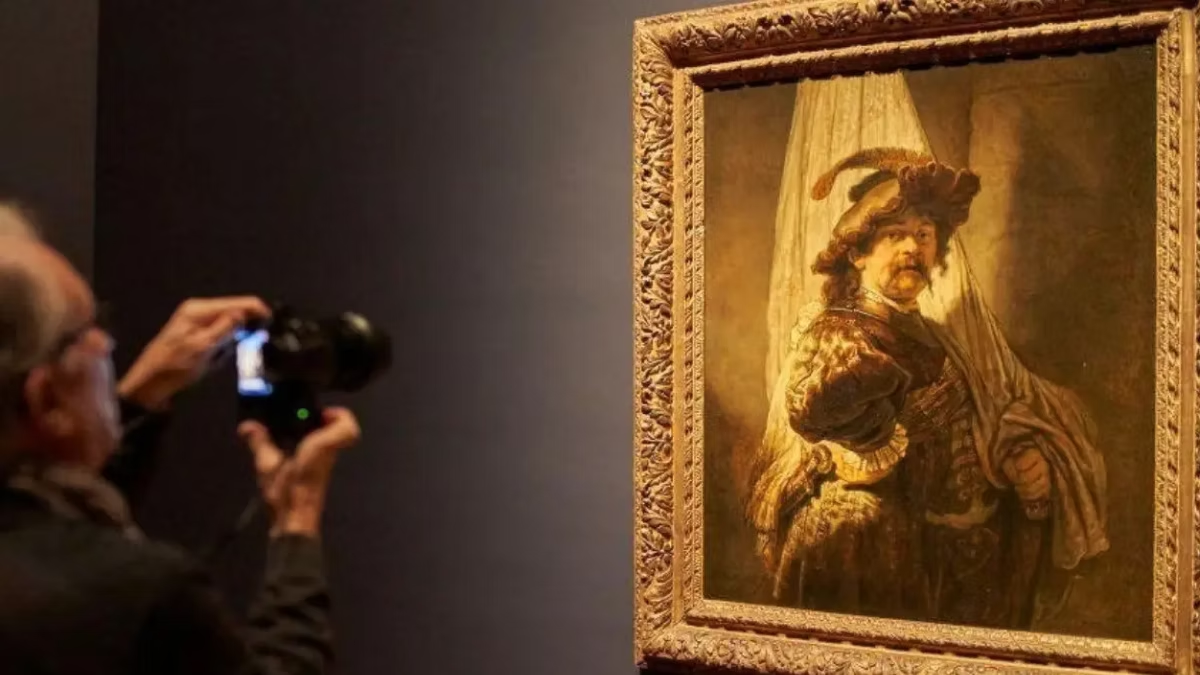
Rembrandt van Rijn painted roughly 80 self-portraits across his 40-year career — more than any other major European artist of his era — making them a body of work that functions as a visual autobiography. The Rijksmuseum holds several of these self-portraits, spanning his career from around age 22 (c. 1628) to age 55 (1661). The two most important are the Young Self-Portrait in Room 2.8 (confident, ambitious, early career) and Self-Portrait as the Apostle Paul (1661) in the Gallery of Honour Rembrandt alcove (weathered, introspective, near the end of his life). Seeing these two together — 33 years apart, painted by the same artist — is one of the Rijksmuseum’s quietest revelations. All self-portraits are on Floor 2 and free with standard entry.
Rembrandt’s self-portraits are unlike any other body of self-imaging in art history. Before him, self-portraits were occasional — artists painted themselves to demonstrate skill or include themselves in larger compositions. Rembrandt made self-portraiture a sustained practice across his entire career, painting himself dozens of times from his early twenties to the year of his death. The result is a visual autobiography you can trace room to room at the Rijksmuseum. This guide covers each of the major Rijksmuseum self-portraits, what they reveal about Rembrandt at that life stage, and why seeing them together matters.
How Many Self-Portraits Did Rembrandt Paint?
Rembrandt created approximately 80 surviving self-images across painting, etching, and drawing — roughly 40 painted self-portraits, 31 etched self-portraits, and a handful of drawings. The count keeps shifting as attributions are re-examined (the Rembrandt Research Project has reclassified several works to his workshop rather than Rembrandt himself in recent decades). What’s not disputed: he painted himself every year or two for most of his career, creating the most sustained self-portrait practice in Western art history before the 20th century.
Why so many?
Several reasons:
- Self-study. Painters used their own face as the most available subject for practising expressions, lighting, and character study.
- Market demand. Rembrandt self-portraits sold well during his lifetime to collectors who wanted a piece by a celebrity artist.
- Artistic ambition. The self-portrait became a genre Rembrandt elevated into its own serious art form — tracking his aging, his changing moods, his self-image.
- Inventory. A painter’s workshop needed sample works. A self-portrait doubled as a marketing piece.
The balance of these reasons shifted across his career. Early self-portraits (1620s-30s) were mostly practice and marketing. Later self-portraits (1650s-60s) became deeply personal artistic statements.
Where to Find Rembrandt’s Self-Portraits at the Rijksmuseum
The Rijksmuseum’s Rembrandt self-portraits are on Floor 2, concentrated in and near the Gallery of Honour. The most important are: the Young Self-Portrait (c. 1628) in Room 2.8 — a side room off the Gallery of Honour corridor — and Self-Portrait as the Apostle Paul (1661) in the Rembrandt alcove of the Gallery of Honour. Additional Rembrandt self-portraits may be displayed elsewhere on Floor 2 depending on current curation. Seeing both in one visit is essential to understanding Rembrandt.
Navigation
- Enter on Floor 0 (main atrium)
- Take stairs or lift up two floors to Floor 2
- Room 2.8 for the Young Self-Portrait — a side room off the Gallery of Honour area, typically near the Rembrandt alcove
- Rembrandt alcove of the Gallery of Honour for Self-Portrait as the Apostle Paul, alongside The Jewish Bride, The Syndics, and other late Rembrandts
See Rijksmuseum Floor Plan & Map.
The Key Self-Portraits in Detail
1. Self-Portrait at a Young Age (c. 1628)
Location: Room 2.8, Floor 2.
Painted when Rembrandt was approximately 22 years old, still based in Leiden before his move to Amsterdam in 1631. One of his earliest mature works.
What you see: – Dramatic back-lighting — Rembrandt’s face is half in shadow, with light striking from behind – Youthful features — visible cheekbones, curly hair, direct gaze – Unfinished-looking quality — the hair is painted with the wooden end of a brush, scratched through wet paint to create a spiky, energetic texture – Small scale — just 22.5 × 18.5 cm
What it reveals: A young artist demonstrating that he could handle light in ways his contemporaries couldn’t. The back-lit composition was technically ambitious — most portraitists of the 1620s avoided it because it’s difficult to render a face convincingly against a brighter background. Rembrandt chose it deliberately to show off.
Why it matters: This is Rembrandt announcing himself as a painter. The confidence is evident, and the lighting innovation that would define his career is already present.
2. Self-Portrait as the Apostle Paul (1661)
Location: Rembrandt alcove, Gallery of Honour, Floor 2.
Painted when Rembrandt was approximately 55 years old, eight years before his death. He depicts himself as the biblical Apostle Paul, holding an epistle and gazing directly at the viewer.
What you see: – Weathered face — deep lines, loose skin, aged features – Contemplative expression — no bravado, no attempt to look younger or more handsome – Religious iconography — Paul’s sword visible behind his shoulder, epistle in his hand – Thick impasto paint — especially on his forehead and beard; you can see the paint’s physical texture – Warm, glowing palette — browns, reds, ambers
What it reveals: The difference between 22-year-old Rembrandt and 55-year-old Rembrandt isn’t just age. It’s a different relationship with self-image. The young Rembrandt was showing off; the old Rembrandt is simply looking, accepting what he sees.
Why it matters: Most 17th-century portraits — including self-portraits — flattered their subjects. Rembrandt’s late self-portraits refuse to flatter. He painted his own aging without vanity, producing images that feel more honest than almost any portrait from his era. Van Gogh, studying Rembrandt in the 1880s, would point to these late works as the supreme achievement of painting.
3. Additional Rembrandt Self-Portraits in the Collection
The Rijksmuseum holds additional Rembrandt self-portraits that are occasionally on display:
- Self-Portrait as a Young Man (late 1620s) — variant of the Young Self-Portrait, slightly different pose
- Self-Portrait in Oriental Costume (c. 1631) — Rembrandt wearing an elaborate turban and fur, exploring exotic identity
- Smaller self-portrait studies — works that rotate through special exhibitions rather than permanent display
The specific selection displayed at any time varies based on curatorial choices. The two described above — Young and Apostle Paul — are usually on permanent display.
The Full Arc: Young Rembrandt vs Old Rembrandt
Seeing both major self-portraits in one visit is the Rijksmuseum’s most quietly profound experience.
| Feature | Young Self-Portrait (c. 1628) | Self-Portrait as the Apostle Paul (1661) |
|---|---|---|
| Rembrandt's age | ~22 | ~55 |
| Year | c. 1628 | 1661 |
| Location now | Room 2.8 | Gallery of Honour alcove |
| Scale | Small (22.5 × 18.5 cm) | Medium |
| Technique | Smooth, dramatic lighting | Thick impasto, warm colour |
| Expression | Direct, confident, slightly guarded | Introspective, accepting |
| What he painted | An ambitious young artist | A weathered, aging man |
| Financial state | Rising | Post-bankruptcy (1656) |
| Personal state | Before marriage to Saskia | After deaths of Saskia (1642), Hendrickje (1663 pending) |
What changed in 33 years
Rembrandt’s life between these two self-portraits was extraordinary:
- 1631 — moved to Amsterdam from Leiden
- 1634 — married Saskia van Uylenburgh
- 1634-1641 — three children died in infancy
- 1641 — son Titus born
- 1642 — The Night Watch completed; Saskia died the same year
- 1649 — began relationship with Hendrickje Stoffels
- 1656 — declared bankruptcy, forced to sell his house and collections
- 1658 — moved to a smaller, rented house
- 1661 — Self-Portrait as the Apostle Paul painted
The technical mastery of the late self-portrait is greater than the early one, but what’s striking is how much life is visible in the face. The young Rembrandt doesn’t yet know his own fragility. The old Rembrandt knows everything.
How Rembrandt’s Self-Portraits Changed Over Time
Three distinct phases in his self-portrait practice:
Early self-portraits (c. 1625-1635)
Characteristics: – Tight, detailed finish – Dramatic lighting experiments – Often in costume (turbans, elaborate clothing, soldier’s armour) – Small-scale studies alongside commissioned works – Still learning his mature style
Example at Rijksmuseum: The Young Self-Portrait.
Middle-period self-portraits (c. 1635-1650)
Characteristics: – More ambitious scale – Confident, wealthy-looking presentation – Rembrandt at the peak of commercial success – Often showing his fashionable Amsterdam life – Technical polish combined with psychological depth
Not strongly represented in the Rijksmuseum’s permanent display; examples exist in other museums (Frick Collection NY, Kenwood House London).
Late self-portraits (c. 1650-1669)
Characteristics: – Thick impasto, heavily textured paint – Warm, glowing palette – Unflinching depiction of aging – Often cast as historical or biblical figures – Financial collapse and personal losses visible in the face – Widely considered his greatest works
Example at Rijksmuseum: Self-Portrait as the Apostle Paul.
Rembrandt’s Self-Portraits Beyond the Rijksmuseum
For context, Rembrandt’s self-portraits are scattered across the world’s major museums:
- Mauritshuis, The Hague — Self-Portrait (1669, the year of his death)
- National Gallery, London — Self-Portrait at the Age of 63 (1669)
- Kenwood House, London — Self-Portrait with Two Circles (c. 1665)
- Frick Collection, New York — Self-Portrait (1658)
- Louvre, Paris — Self-Portrait at the Easel (1660)
- Isabella Stewart Gardner Museum, Boston — Self-Portrait Age 23 (1629)
- Metropolitan Museum of Art, New York — Several self-portraits
If you’re serious about Rembrandt’s self-portraiture, combining a Rijksmuseum visit with Mauritshuis (50 min by train from Amsterdam) lets you see three late self-portraits in one week — a rare concentration.
Why Seeing Both Self-Portraits Matters
Most Rijksmuseum visitors see The Night Watch and The Milkmaid and move on. The two self-portraits require an extra five minutes each and genuinely change your relationship with Rembrandt.
What you learn from seeing both:
- Rembrandt’s career wasn’t an upward curve. It was a rise, a peak, then a long decline — and the late paintings are where his greatest art lives.
- Technical mastery isn’t the same as artistic mastery. The young Rembrandt paints more tightly and impressively; the old Rembrandt paints with less visible skill and more psychological truth.
- Dutch Golden Age portraiture was willing to show aging. Unlike much European portraiture, Dutch painters — especially Rembrandt — didn’t flatter their subjects into timeless youth.
- Self-portraiture as a genre can be a life’s work. This idea — which seems obvious in the 20th century after Picasso, Frida Kahlo, and countless others — was essentially invented by Rembrandt.
Photography
Handheld photography without flash is permitted. The Young Self-Portrait is small and benefits from close, careful photography. The Apostle Paul self-portrait is larger and the impasto photographs well at close range with good lighting. Both paintings may have slight glass glare; try slight angles.
See Rijksmuseum Photography Rules.
Frequently Asked Questions
How many self-portraits did Rembrandt paint?
Approximately 80 surviving self-images across his career — roughly 40 painted self-portraits, 31 etched self-portraits, and a handful of drawings. He painted himself on average every year or two across his 40-year career.
Which self-portraits are at the Rijksmuseum?
The two most important are the Young Self-Portrait (c. 1628) in Room 2.8 and Self-Portrait as the Apostle Paul (1661) in the Rembrandt alcove of the Gallery of Honour. Additional self-portraits from the Rijksmuseum collection are occasionally on display.
Why did Rembrandt paint so many self-portraits?
A combination of self-study (practising expressions and lighting), market demand (self-portraits sold well), artistic ambition (he elevated self-portraiture into a serious genre), and workshop inventory. The emphasis shifted across his career — early self-portraits were more for practice and marketing; late ones were deeply personal.
Where is the Self-Portrait as the Apostle Paul?
In the Rembrandt alcove of the Gallery of Honour on Floor 2, alongside The Jewish Bride, The Syndics, and other late Rembrandts. The painting shows Rembrandt at age 55 depicting himself as the biblical Apostle Paul.
Is Rembrandt’s Young Self-Portrait considered important?
Yes — despite its small scale (22.5 × 18.5 cm), it’s a landmark early work. The dramatic back-lighting was technically ambitious for a 22-year-old painter and shows Rembrandt’s signature handling of light already developed.
Can I see Rembrandt self-portraits included in the standard ticket?
Yes. All Rembrandt self-portraits at the Rijksmuseum are in areas accessible with standard €25 entry (free for under-18s). No separate booking required.
How does Rembrandt’s Young Self-Portrait compare to his later work?
Dramatically different. The Young Self-Portrait (c. 1628) is tight, dramatically lit, confident but relatively smooth in finish. The late self-portraits (1650s-60s) are thicker in paint, warmer in colour, and psychologically more open. Seeing both in one visit is essential.
What’s Rembrandt’s most famous self-portrait?
Opinions differ. Commonly named as his greatest self-portraits: the Self-Portrait at the Age of 63 (National Gallery London, 1669), the Self-Portrait with Two Circles (Kenwood House London, c. 1665), and the Self-Portrait at the Easel (Louvre, 1660). The Rijksmuseum’s Apostle Paul is also on most scholars’ shortlists.
Did Rembrandt ever paint himself smiling?
Rarely, and usually in contexts that seem ironic or complicated rather than genuinely cheerful. Unlike his contemporary Frans Hals (who painted genuine laughter in The Merry Drinker), Rembrandt’s self-portraits are almost entirely serious, contemplative, or mournful.
Are there self-portrait drawings by Rembrandt?
Yes, but most are not on permanent display. The Rijksmuseum’s extensive Rembrandt drawing and etching collection is mostly kept in storage and rotated through special exhibitions. Check the museum’s current exhibition programme.
Can I see Rembrandt’s self-portraits online?
Yes. The Rijksmuseum’s Rijksstudio (rijksmuseum.nl/en/rijksstudio) offers all its Rembrandt self-portraits in ultra-high-resolution free download.
