
Vermeer Paintings at the Rijksmuseum (2026): All Four Works Explained
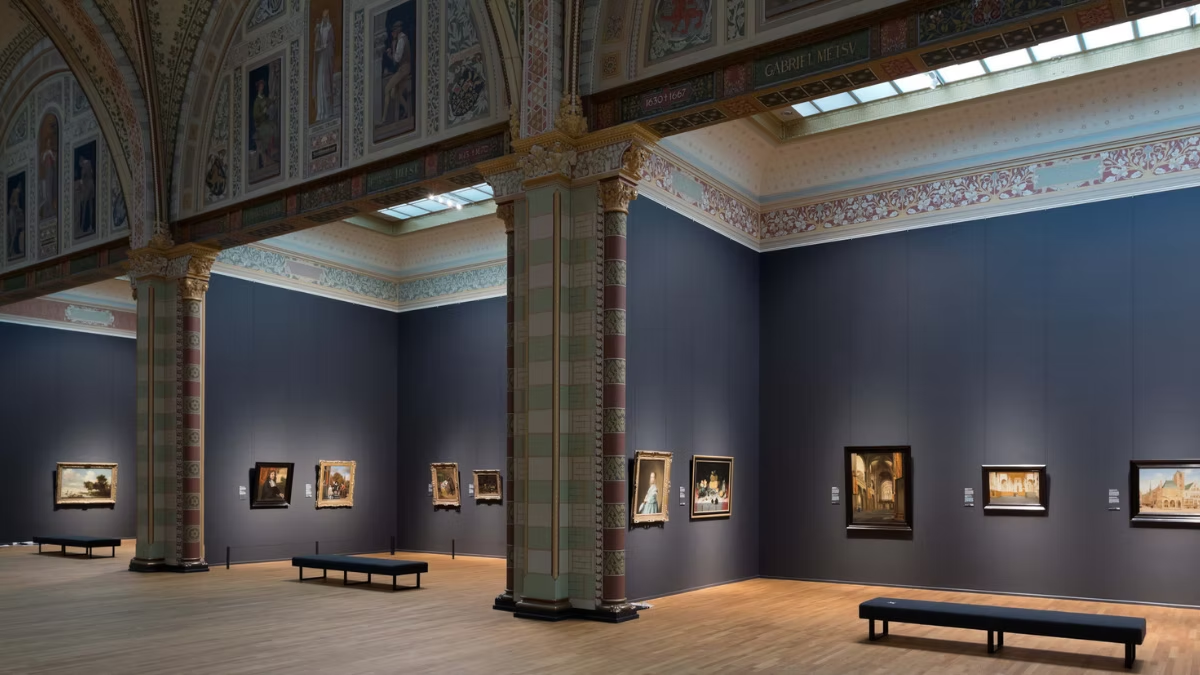
The Rijksmuseum holds four paintings by Johannes Vermeer — one of only two museums in the world with four or more (alongside the Frick Collection in New York, which has three, and the Mauritshuis in The Hague with three). The four Rijksmuseum Vermeers are: The Milkmaid (c. 1658-59), The Little Street (c. 1658), Woman Reading a Letter (c. 1663), and Woman with a Water Pitcher (c. 1664, on long-term loan from the Metropolitan Museum of Art, New York). All four hang together in the Gallery of Honour on Floor 2, making the Rijksmuseum one of the most important Vermeer destinations in the world. Of the 34 known Vermeer paintings that survive worldwide, four of them are in this one gallery.
Vermeer is one of those artists whose reputation dramatically exceeds his output. He painted slowly, produced maybe 45 paintings in his lifetime, of which only 34 survive — making each surviving work globally significant. The Rijksmuseum’s four Vermeers represent more than 10% of his entire known oeuvre. This guide covers each of the four in detail, where they hang in the museum, what to look for, and how Vermeer fits into the broader Dutch Golden Age story told by the Rijksmuseum collection.
How Many Vermeers Are at the Rijksmuseum?
Four paintings by Johannes Vermeer are on display at the Rijksmuseum. Three are owned by the museum — The Milkmaid, The Little Street, and Woman Reading a Letter. The fourth, Woman with a Water Pitcher, is on long-term loan from the Metropolitan Museum of Art in New York. All four hang together in the Gallery of Honour on Floor 2 of the Rijksmuseum. Of the 34 known Vermeer paintings that survive in museums and private collections worldwide, the Rijksmuseum holds more than 10% of the total.
Where the four Vermeers hang
All four are in the Vermeer alcove of the Gallery of Honour on Floor 2, typically within a few metres of each other. The alcove is the first or second one you’ll encounter walking from the Great Hall toward the Night Watch Room. See Rijksmuseum Floor Plan & Map.
The global Vermeer count
Of Vermeer’s surviving paintings:
- Mauritshuis, The Hague — 3 Vermeers (including Girl with a Pearl Earring and View of Delft)
- Rijksmuseum, Amsterdam — 4 Vermeers
- Metropolitan Museum of Art, New York — 5 Vermeers (one on loan to Rijksmuseum)
- Frick Collection, New York — 3 Vermeers
- National Gallery of Art, Washington DC — 4 Vermeers
- Kunsthistorisches Museum, Vienna — 1 Vermeer (The Art of Painting)
- Städel Museum, Frankfurt — 1 Vermeer (The Geographer)
- National Gallery, London — 2 Vermeers
- Louvre, Paris — 2 Vermeers
- Plus single works in various other museums and private collections
The Rijksmuseum, Met, and National Gallery Washington are the three most important Vermeer destinations in the world.
The Four Vermeers, In Detail
1. The Milkmaid (c. 1658-1659)
The most famous Vermeer at the Rijksmuseum and one of the most famous paintings in the world. A servant woman carefully pouring milk into a bowl in a plain kitchen.
- Size: 45.5 × 41 cm (very small)
- Medium: Oil on canvas
- Acquired: 1908 via national fundraising campaign
- What to look for: Pointillé dots (tiny painted highlights), the expensive ultramarine apron, the cupid tile at the bottom
See our dedicated guide: The Milkmaid by Vermeer.
2. The Little Street (c. 1658)
One of only two surviving outdoor Vermeer scenes (the other is View of Delft at the Mauritshuis, The Hague). A view of canal houses on a small street in Delft, Vermeer’s home city. Two women work in the doorway and an archway, children play in the street.
Why it matters: – Rare landscape subject from an artist who mostly painted interiors – The only surviving street view in Vermeer’s output that’s a complete composition – Scholars have recently identified the specific location — probably Vlamingstraat 40-42 in Delft — where Vermeer’s aunt Ariaentge Claes lived
Size: 54.3 × 44 cm — still small but slightly larger than The Milkmaid
What to look for: – The brickwork — every brick is individually articulated – The two women in the doorway and arch — probably based on Vermeer’s neighbours – The children — tiny figures at play, adding narrative depth – The red tile at the very top — Vermeer’s signature use of a single vivid colour to anchor an otherwise subdued composition – The architecture — pre-renovation 17th-century Dutch domestic buildings rarely survived, so this is a visual document of a world that’s now mostly gone
3. Woman Reading a Letter (c. 1663)
A woman in profile, standing at a window, reading a letter. One of Vermeer’s most quintessentially characteristic paintings — interior scene, light from the left, a woman absorbed in a private moment.
Size: 46.5 × 39 cm
What to look for: – The luminous blue jacket — painted with expensive ultramarine pigment, imported as lapis lazuli from Afghanistan. Vermeer used more ultramarine than almost any other painter of his era. – The unseen letter writer — a common Vermeer device. The absent correspondent matters as much as the woman reading. – The pregnancy question — scholars have debated for decades whether the woman in this painting is pregnant. Current consensus leans toward no (the jacket’s cut is characteristic of 17th-century fashion, not obvious pregnancy), but the debate continues. – The wall map — probably a 1620s map of Holland. Vermeer used maps in several paintings, both as realistic interior decoration and as symbols of the Dutch Republic’s trading empire. – The absence of windows in the frame — you can see light entering from the left but the actual window is cropped out. Vermeer does this in several paintings.
4. Woman with a Water Pitcher (c. 1664)
On long-term loan from the Metropolitan Museum of Art, New York. A woman in a starched white cap and blue apron holds a pewter water pitcher while opening a window with her other hand. Another quintessential Vermeer interior.
Size: 45.7 × 40.6 cm
Note: Because the painting is on loan, check the museum’s current display status before visiting if seeing this specific Vermeer is a priority. Long-term loans periodically return to the lending institution — though the Met-Rijksmuseum loan arrangement has been in place for many years.
What to look for: – The pewter pitcher — Vermeer’s precision in painting metal is extraordinary. Look at the reflections on the surface. – The stained-glass window — a common feature in upper-class 17th-century Dutch homes – The table with rug — Oriental rugs on tables (not floors) were luxury items in Dutch Golden Age domestic life – The woman’s contemplation — like most Vermeer figures, she’s in a moment of quiet thought rather than direct interaction with the viewer
Comparison at a glance
| Painting | Year | Size | Owned/loaned |
|---|---|---|---|
| The Milkmaid | c. 1658-59 | 45.5 × 41 cm | Owned |
| The Little Street | c. 1658 | 54.3 × 44 cm | Owned |
| Woman Reading a Letter | c. 1663 | 46.5 × 39 cm | Owned |
| Woman with a Water Pitcher | c. 1664 | 45.7 × 40.6 cm | On loan from Met NY |
All four paintings are roughly the same small scale — typical of Vermeer’s output.
Who Was Johannes Vermeer?
Johannes Vermeer (1632-1675) was a Dutch painter from Delft who produced a small body of 34 known surviving paintings, mostly quiet interior scenes of women at everyday tasks, bathed in characteristic window light from the left. He died in debt at age 43, leaving his wife Catharina and 11 children bankrupt. His reputation collapsed after his death and was largely forgotten for two centuries until French critic Théophile Thoré-Bürger rediscovered him in the 1860s. By the early 20th century he was considered one of the supreme painters in Western art history. His mysterious life — few biographical details survive — has added to his mystique.
Key biographical facts
- Born: October 1632, Delft, Netherlands
- Died: December 1675, Delft (age 43)
- Wife: Catharina Bolnes (married 1653, 15 children together though 4 died in infancy)
- Patron: Pieter van Ruijven, a wealthy Delft collector who bought most of Vermeer’s output during his lifetime
- Second career: Art dealer — Vermeer supplemented his painting income by selling other artists’ work
- Painted slowly: Maybe 2-3 paintings per year at his peak
- Financial collapse: The 1672 “Rampjaar” (Disaster Year) of the Dutch Republic crashed the art market; Vermeer died three years later unable to pay debts
Why he was forgotten
When Vermeer died, his work was held almost entirely by Pieter van Ruijven’s estate. Over the following 200 years, his paintings were attributed to other artists (Pieter de Hooch was a common misattribution), sold under false names, or simply forgotten. No major exhibitions, no publications, no reproductions.
The rediscovery
Thoré-Bürger, writing in the 1860s, pieced together Vermeer’s scattered paintings and published the first scholarly study of his work in 1866. From that point forward, Vermeer’s reputation rose rapidly. By 1900 he was celebrated as one of the great Dutch masters; by 2000 he was on a shortlist of the handful of supreme European painters.
The 2023 Vermeer exhibition at the Rijksmuseum
In early 2023, the Rijksmuseum mounted the largest Vermeer exhibition ever held — 28 of the 34 surviving Vermeer paintings were displayed together, an unprecedented gathering. The exhibition drew 650,000 visitors and sold out months in advance. It was a once-in-a-century event; comparable loans are unlikely to be arranged again in our lifetimes.
The four Rijksmuseum Vermeers remain on permanent display; after the 2023 exhibition they returned to their usual Gallery of Honour locations.
What Makes Vermeer Distinctive
Seeing four Vermeers in one gallery makes it possible to identify the elements that define his style:
1. Window light from the left
Almost every Vermeer interior has a window on the left, casting natural light across the scene. This is not a coincidence — Vermeer’s home had windows facing north on the left side, and he likely painted in his own domestic setting.
2. Quiet, internal subjects
Vermeer rarely paints action, violence, drama, or narrative. His subjects are caught in moments of private thought — pouring milk, reading, holding a pitcher, playing music. The stillness is the point.
3. Expensive pigments, prominently displayed
Vermeer used more natural ultramarine (the most expensive pigment of the era) than almost any contemporary. This was a financial decision as much as an artistic one — Pieter van Ruijven paid premium prices for paintings that used premium materials.
4. Small scale
Most Vermeers are 40-60 cm in either dimension. These are intimate paintings designed for close viewing in small domestic rooms, not grand civic spaces.
5. The pointillé technique
Highlights appear as tiny painted dots rather than smooth gradients — visible on bread, jewellery, reflective surfaces. You can see this technique clearly on The Milkmaid and Woman with a Water Pitcher.
6. Camera obscura use (debated)
Some scholars believe Vermeer used a camera obscura — a primitive optical device projecting an image onto a surface — to help with his compositions. The evidence is debated but strong: certain paintings have optical characteristics that match a camera obscura (slight blurring of foreground elements, pointillé highlights resembling overexposure).
7. Absent narratives
A letter is being read but we don’t know from whom or saying what. A woman holds a pitcher but we don’t know why. A milkmaid pours milk but the story stops there. This narrative silence is a consistent feature.
How to See the Four Vermeers With the Best Experience
The Gallery of Honour becomes genuinely crowded between 10:30 AM and 3:00 PM, especially in the Vermeer alcove (small works mean people crowd close to see detail).
Best strategy:
- Book the 9:00 AM opening slot — this gives you 15-20 minutes in the Vermeer alcove with minimal crowding
- Head directly to Floor 2 via the main staircase — don’t stop at anything on Floor 0
- Spend 5-8 minutes per Vermeer — these are paintings that reward close, slow looking
- Then continue through the Gallery of Honour — by the time you’ve finished the Vermeers, the crowd will be arriving, and you can visit the Rembrandts and other works while the Vermeer alcove clears
What not to do: Arrive at 11 AM expecting to spend quality time with Vermeer. You’ll be standing behind 6-8 people at each painting, with limited close-viewing time.
Beyond the Four: Vermeer Across Amsterdam
The four Rijksmuseum Vermeers are the only Vermeer paintings on permanent display in Amsterdam. For more Vermeer:
- Mauritshuis, The Hague — 3 Vermeers including Girl with a Pearl Earring and View of Delft. 50 minutes by train from Amsterdam.
- Delft itself — Vermeer’s home city, a small historic town 1 hour from Amsterdam by train. The Vermeer Centrum Delft has reproductions and contextual material but no original paintings.
- Met, New York and National Gallery Washington DC — biggest American Vermeer collections
If you’re in Europe and serious about Vermeer, combining the Rijksmuseum with a day trip to the Mauritshuis gives you seven of the 34 surviving Vermeer paintings in one week — about 20% of the artist’s total output.
Photography
Handheld photography is permitted, no flash. The Vermeer paintings are small and often have some glare from protective glass at certain angles — try slight angle adjustments for clearer shots. The Rijksmuseum’s Rijksstudio (rijksmuseum.nl/en/rijksstudio) offers all four Vermeers in ultra-high resolution for free download, better quality than any phone photo.
Frequently Asked Questions
How many Vermeer paintings are at the Rijksmuseum?
Four: The Milkmaid, The Little Street, Woman Reading a Letter, and Woman with a Water Pitcher (the last on long-term loan from the Metropolitan Museum of Art in New York). All four hang in the Gallery of Honour on Floor 2.
How many Vermeer paintings exist in total?
Approximately 34 surviving paintings worldwide, held in major museums and a handful of private collections. Vermeer may have painted 40-50 in his lifetime, but only 34 are currently recognised by scholars.
Which museum has the most Vermeer paintings?
The Metropolitan Museum of Art, New York has the largest collection at 5 Vermeers (one currently on loan to the Rijksmuseum, so 4 on display in NYC). The Rijksmuseum and the National Gallery of Art in Washington DC each have 4. The Mauritshuis (The Hague) and Frick Collection (New York) each have 3.
What is the most famous Vermeer painting at the Rijksmuseum?
The Milkmaid (c. 1658-59) — the most-viewed Vermeer in the collection and one of the most famous paintings in the world. See our dedicated guide: The Milkmaid by Vermeer.
Where are the Vermeer paintings in the Rijksmuseum?
All four are displayed together in the Vermeer alcove of the Gallery of Honour, Floor 2. Walk up from the main atrium to Floor 2, enter the Great Hall, and the Vermeer alcove is one of the first on your left as you enter the Gallery of Honour.
Why is Woman with a Water Pitcher on loan from the Met?
A long-standing loan arrangement between the Rijksmuseum and the Metropolitan Museum of Art. The Met holds several Vermeers and has loaned this one for display in Amsterdam for many years. The arrangement continues as of 2026 but could theoretically end in future — check current display status before visiting if this specific painting is a priority.
Was the 2023 Vermeer exhibition at the Rijksmuseum sold out?
Yes. The 2023 exhibition gathered 28 of the 34 known Vermeer paintings and was effectively sold out for months. It was the largest Vermeer exhibition ever mounted and a once-in-a-century event. The four Rijksmuseum Vermeers returned to permanent display in the Gallery of Honour after the exhibition closed.
Can I see Vermeer’s house or studio?
No. Unlike Rembrandt (whose Amsterdam house is preserved as the Rembrandt House Museum), Vermeer’s home and studio in Delft have not survived. The Vermeer Centrum Delft provides contextual material and reproductions but no original work or direct historical space.
Where did Vermeer live and work?
Vermeer lived his entire life in Delft, Netherlands. He never moved to Amsterdam despite Amsterdam being the larger art market. Most of his paintings are now held outside the Netherlands — a slight irony for such a quintessentially Dutch artist.
How much is a Vermeer painting worth?
The last major Vermeer to come to auction was “Young Woman Seated at a Virginal” in 2004, which sold for £16.2 million. Current estimates for any surviving Vermeer reaching auction would likely exceed €150-200 million. None of the four Rijksmuseum Vermeers will come to market — they’re all in permanent museum collections.
Can I photograph Vermeer paintings at the Rijksmuseum?
Yes. Handheld personal photography is permitted without flash, tripods, or selfie sticks. See Rijksmuseum Photography Rules. For ultra-high-resolution images, download the museum’s Rijksstudio files for free.
