
Rijksmuseum Building (2026): Pierre Cuypers Architecture & History Guide
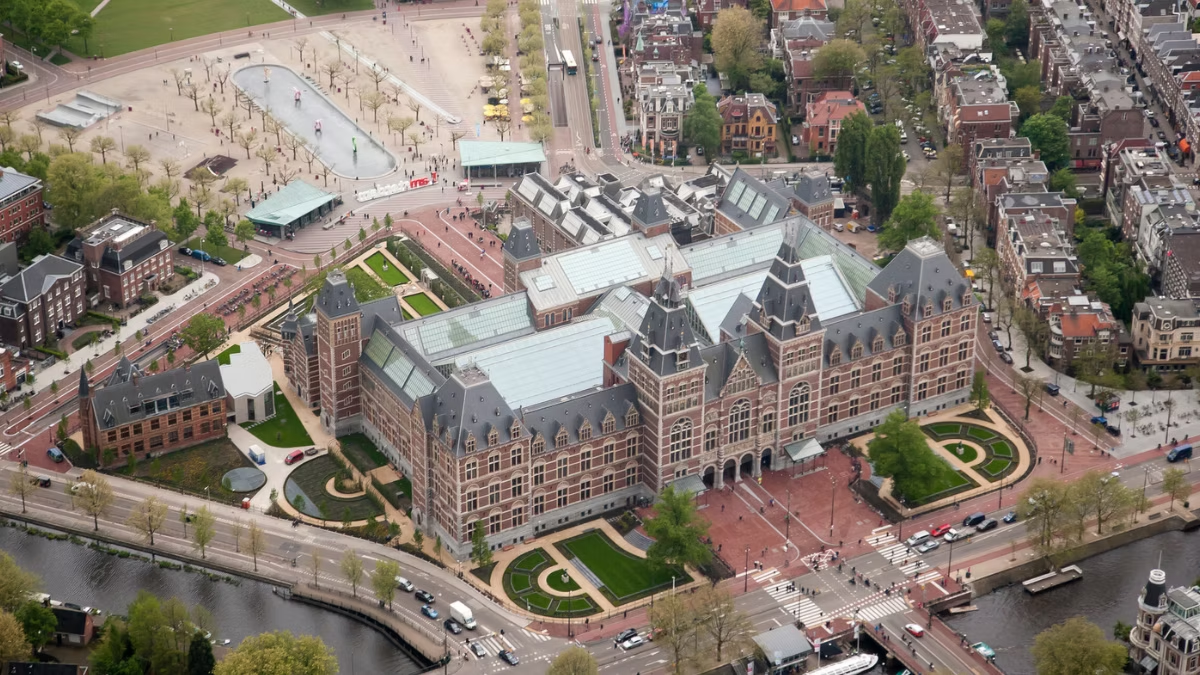
The Rijksmuseum building was designed by the Dutch architect Pierre Cuypers (1827-1921) and opened in 1885. It’s a massive neo-Gothic/neo-Renaissance mixed structure built of brick and stone, decorated with stained glass, mosaics, sculpture, and painted ornament throughout. Cuypers modelled the building in part on medieval cathedrals — the Gallery of Honour is laid out like a nave with side chapels, and the building’s Catholic-influenced decoration was enormously controversial in Protestant 19th-century Holland. The building underwent a major renovation from 2003 to 2013 by Spanish firm Cruz y Ortiz, reopening with modernised facilities while preserving Cuypers’ original design. The building itself — separate from the art inside — is considered one of the most important works of 19th-century European institutional architecture.
Most visitors to the Rijksmuseum come for the art and experience the building as a backdrop. But the building itself is a major work of architecture — designed by one of the most influential Dutch architects of the 19th century, built with encyclopedic decorative programme, and nearly as important to the Rijksmuseum’s identity as the paintings inside. This guide covers the architecture, the history, the key spaces worth studying, and what to look for as you walk through.
The Architect: Pierre Cuypers
Pierre Cuypers (1827-1921) was the most influential Dutch architect of the 19th century and the leading figure in the Dutch Gothic Revival. Born in Roermond to a devout Catholic family, he trained in Belgium and built a career designing churches, state institutions, and private commissions across the Netherlands. His most important works are the Rijksmuseum (1885) and Amsterdam Centraal Station (1889) — both landmark buildings that define Amsterdam’s skyline. He was a deeply religious Catholic who infused his public buildings with ecclesiastical references and decoration, which generated controversy in the officially Protestant Dutch state.
Key biographical facts
- Born: 1827, Roermond, Netherlands
- Education: Royal Academy of Fine Arts, Antwerp
- Career: 60+ years as an active architect
- Major churches: Over 100 Catholic churches across the Netherlands
- Major state commissions: The Rijksmuseum (1876-1885), Amsterdam Centraal Station (1882-1889), the Heilig Landstichting (1904)
- Son: Joseph Cuypers, who became an architect and worked with his father
- Nephew: Eduard Cuypers, also an important Dutch architect
- Died: 1921, Roermond (aged 93)
Why Cuypers was chosen for the Rijksmuseum
In the 1870s the Dutch government held a design competition for a new national museum. Cuypers won — despite controversy about his Catholic background — because:
- His technical skill was unmatched
- He had proven experience with large-scale institutional buildings
- His design successfully combined Dutch historic architectural traditions (Renaissance, Gothic) with modern functional requirements
- He was willing to work collaboratively with the government on the complex brief
His religious affiliations would become a source of ongoing tension during construction.
The Building’s Architecture
The Rijksmuseum is a large rectangular building approximately 142 metres long by 60 metres wide with a distinctive central passage (the Onderdoorgang) splitting the ground level — this passage is a public street that bicycles and pedestrians use to cut through the building. Above the passage, the museum’s grand halls soar to four floors. The exterior is red brick and light stone decorated with turrets, spires, gabled roofs, stained glass, and sculptural detailing. The style mixes Neo-Gothic, Neo-Renaissance, and Dutch historical architecture. Constructed 1876-1885, renovated 2003-2013.
Exterior features
As you approach the building from Museumplein, look for:
- The central passage (Onderdoorgang) — the arched public walkway cutting through the building
- The two towers flanking the main entrance
- Decorative sculpture over the main entrance — allegorical figures representing art, industry, history
- Stained glass windows visible on multiple sides
- The distinctive red-brick-and-stone pattern — characteristic of Cuypers’ style
- Gabled roofs — Dutch architectural heritage reference
- The Royal coat of arms displayed prominently on the central facade
The central passage (Onderdoorgang)
One of the building’s most unusual features. The Rijksmuseum sits over a public street — the passage is used daily by cyclists and pedestrians crossing through. This was controversial during design (critics argued a museum should be sealed off, not integrated with the city) but has become one of the building’s defining features. The passage is acoustically famous — the harpist or string quartet playing here most days uses the vaulted space’s natural acoustics.
Walking through the passage is free and doesn’t require a museum ticket — it’s genuinely part of Amsterdam’s urban fabric.
The Interior: Four Essential Spaces
1. The Great Hall (Voorhal)
Where: Floor 2, entrance from the main staircase.
The ceremonial entrance to the Gallery of Honour. Features:
- Stained glass windows depicting allegorical figures (the arts, sciences, faith, work)
- Mosaic floor with decorative patterning
- Ceiling paintings illustrating Dutch history
- Sculptural detailing throughout
Spend 2-3 minutes here before moving into the Gallery of Honour. Most visitors walk straight through without looking up.
2. The Gallery of Honour (Eregalerij)
Where: Floor 2, main axis.
The heart of the building — a long corridor with side alcoves designed to hold the museum’s most important paintings. Architecturally:
- Laid out like a cathedral nave — long central axis, side “chapel” alcoves
- High vaulted ceilings creating dramatic space
- The Night Watch Room at the far end — where a cathedral’s high altar would be
- Brick and stone detailing in Cuypers’ signature style
See Dutch Golden Age Painting: A Beginner's Guide.
3. The Night Watch Room
Where: Floor 2, end of the Gallery of Honour.
Purpose-built to house The Night Watch. Reconstructed during the 2013 renovation to improve viewing conditions and accommodate Operation Night Watch restoration. See The Night Watch by Rembrandt.
4. The Cuypers Library
Where: Floor 1, Room 1.13.
Cuypers’ architectural personal favourite — a three-storey working library with cast-iron spiral staircases, wrought-iron balustrades, and floor-to-ceiling leather-bound books. Visible through a glass wall. See The Cuypers Library.
The 2003-2013 Renovation
The building underwent a major decade-long renovation from 2003 to 2013, led by the Spanish architectural firm Cruz y Ortiz. Key changes:
- Modernised atrium — the entrance was moved and enlarged; the original smaller entrance area was reconfigured as public space
- New Asian Pavilion — purpose-built new wing (see Asian Pavilion)
- Updated climate control — modern conservation standards require precise humidity and temperature control
- Renovated Night Watch Room — improved lighting, accommodation for the Operation Night Watch glass chamber
- Restored Cuypers decoration — many of Cuypers’ original painted and mosaic details had been covered over or damaged in 20th-century modifications; the renovation carefully restored them
- New underground passages — connecting the building for staff and service access
- Accessibility improvements — lifts, ramps, and modern accessibility throughout (see Accessibility)
The renovation controversy
The renovation took 10 years — much longer and more expensive than originally planned (final cost: approximately €375 million). Critics called it mismanaged; defenders pointed out that restoring a 120-year-old building to modern operational standards is inherently complex.
The result is widely considered a success — the building now functions as a modern museum while preserving Cuypers’ original vision.
The Religious Controversy
Pierre Cuypers was a devout Catholic who incorporated Catholic religious imagery and medieval church architecture into the Rijksmuseum — a building for the Protestant Dutch state. This generated ongoing controversy during construction, with Protestant politicians objecting to the cathedral-like design. Cuypers largely won the battles — his vision was built — but the tensions are embedded in the building’s history. The Gallery of Honour looks like a nave because Cuypers made it look like a nave, against significant institutional resistance.
What was at stake
In the 19th-century Netherlands, Protestant-Catholic tensions still shaped public life. The Dutch Republic had emerged as a Protestant state in the 16th century; Catholics had been legal but marginalised for centuries. When Cuypers was designing a national institution for the Dutch state, the question “should it look like a Catholic cathedral?” was politically charged.
What critics objected to
- Stained glass windows with religious imagery
- Saints and biblical figures in exterior sculpture
- Cathedral-like spatial organisation
- Catholic iconographic references in decorative programme
Cuypers’ response
He largely refused to compromise. His argument was that:
- These elements were architectural traditions, not specifically religious statements
- Dutch historical architecture (medieval and Renaissance) included these elements
- The building needed grandeur and ceremony, which these elements provided
The resolution
Cuypers won most of the design battles. The Protestant Prime Minister Abraham Kuyper famously refused to attend the 1885 opening because of the Catholic design elements. But the building stands as Cuypers designed it, and modern visitors appreciate rather than object to the cathedral-like quality.
The Decorative Programme
Cuypers didn’t just design the building — he designed a total decorative programme covering every surface. This includes:
Wall paintings
Multiple areas have original Cuypers-designed painted ornament — particularly in the Great Hall and stairwells. Much of this was covered in the 20th century and revealed/restored during the 2013 renovation.
Stained glass
The windows tell stories about Dutch history, the arts, and civic virtues through figurative imagery. Best examples are in the Great Hall.
Mosaics
Floor and wall mosaics throughout the ceremonial spaces, featuring patterns, symbols, and occasionally figurative designs.
Sculpture
Both exterior (allegorical figures over the entrance) and interior (decorative details on capitals, corbels, and doorways). Cuypers employed the leading Dutch sculptors of the era for this work.
Tilework
Intricate tile patterns in stairwells, corridors, and ceremonial spaces. Dutch ceramic tradition was important to Cuypers and he used it extensively.
Cuypers’ Other Major Works in Amsterdam
If you’re interested in Cuypers, two other major buildings in Amsterdam are his work:
Amsterdam Centraal Station (1889)
The grand train station, a 5-minute walk from the Rijksmuseum (or a short tram ride). Cuypers designed it in the same neo-Gothic/neo-Renaissance style as the Rijksmuseum — the two buildings are often called “architectural siblings.” The station is free to walk through as a working public space.
Multiple churches
Dozens of Catholic churches across Amsterdam, mostly in the Jordaan and suburbs. The Posthoornkerk (Haarlemmer Houttuinen) and Vondelkerk (Vondelstraat, near Vondelpark) are among the most visible.
The Centraal-Rijksmuseum symmetry
One of Amsterdam’s most overlooked architectural facts: Cuypers deliberately designed the Rijksmuseum (at the south end of the city centre) and Centraal Station (at the north end) as visual bookends of Amsterdam’s historic centre. Both buildings share architectural vocabulary — red brick, stone detailing, towers, gabled roofs — making them instantly recognisable as belonging together.
How to Study the Building During Your Visit
Dedicated architectural walk
If you want to focus on the architecture specifically, plan:
- Start outside — walk around the building looking at the exterior before entering. 15 minutes.
- Through the central passage (Onderdoorgang) — study the vaulted ceiling and stonework. 5 minutes.
- Main atrium — 2013 renovation area; note the contrast with the Cuypers sections. 5 minutes.
- Great Hall — Cuypers at his most ceremonial. 10 minutes.
- Gallery of Honour — walk slowly, noting architectural details between paintings. 10 minutes.
- Cuypers Library viewing gallery — the architectural highlight. 15 minutes.
- Interior stairwells and corridors — tilework, painted details. 10 minutes.
Total: 60-75 minutes for a focused architectural visit, in addition to whatever time you spend with the art.
During a normal visit
Even on a painting-focused visit, pay attention to:
- Where you walk — the building guides you through a deliberate sequence of spaces
- Ceiling details — look up in every major room
- Stairwells — between floors, you’ll pass through some of Cuypers’ most ornate spaces
- Window glass — stained glass appears in unexpected places throughout
Visiting and Photography
The building as a whole is free to look at
You don’t need a ticket to see the building’s exterior or walk through the central passage. The Cuypers Library viewing gallery is inside the museum and requires a ticket.
Exterior photography
The building photographs best from Museumplein (the square to the north) or from the Singelgracht canal to the east. Morning light is most flattering on the south-facing facade; late afternoon light is best from the east.
Interior photography
Handheld photography without flash is permitted throughout. Architectural details reward close study — tilework, sculpture, and painted ornament all photograph well. See Rijksmuseum Photography Rules.
Frequently Asked Questions
When was the Rijksmuseum building built?
Constructed 1876-1885, opened to the public in 1885. The building has operated as the Rijksmuseum continuously since then, with a major renovation from 2003 to 2013.
Who designed the Rijksmuseum?
Pierre Cuypers (1827-1921), the leading Dutch neo-Gothic architect of the 19th century. Cuypers also designed Amsterdam Centraal Station (1889), which shares visual vocabulary with the Rijksmuseum.
What architectural style is the Rijksmuseum?
A mix of Neo-Gothic, Neo-Renaissance, and Dutch historical architectural traditions. Cuypers deliberately combined these styles to create a building that felt both internationally impressive and specifically Dutch.
What’s the central passage that cuts through the Rijksmuseum?
The Onderdoorgang (Dutch for “passage”) — a public walkway that runs through the building at ground level, used daily by pedestrians and cyclists. It’s one of the building’s most unusual features and is acoustically famous (musicians often perform here).
Is the Rijksmuseum building related to Amsterdam Centraal Station?
Yes. Both buildings were designed by Pierre Cuypers and built around the same time (1885 and 1889). They share architectural vocabulary — red brick, stone detailing, towers, gabled roofs — and are often called “architectural siblings” bookending Amsterdam’s historic centre.
Why did the Rijksmuseum renovation take 10 years?
The 2003-2013 renovation was unusually complex because: (1) Cuypers’ original building needed substantial conservation and repair; (2) modern museum operational requirements (climate, security, accessibility) required major infrastructure changes; (3) integrating new spaces (like the Asian Pavilion) with the historic building required careful architectural work; (4) the building had to remain partially functional during much of the work. Final cost: approximately €375 million.
Who designed the 2013 renovation?
Cruz y Ortiz, a Spanish architectural firm based in Seville. They also designed the new Asian Pavilion added during the renovation.
Why is the Gallery of Honour shaped like a cathedral?
Pierre Cuypers was a devout Catholic who deliberately modelled the Rijksmuseum’s central axis on a medieval Gothic cathedral — long central nave (Gallery of Honour), side chapels (the alcoves), ceremonial entrance (Great Hall), “high altar” at the end (Night Watch Room). This was enormously controversial in the Protestant Dutch state at the time of construction, but Cuypers insisted on the design.
Can I tour the Rijksmuseum building?
The museum occasionally runs architectural tours as special events, but no regular architectural-focused public tour. Some private tours can be customised to focus on the building rather than the art — request this at booking.
Is the Rijksmuseum building protected as a historic monument?
Yes. The building is on the Dutch national monument register (Rijksmonument) and subject to strict preservation requirements. All renovations must be approved by Dutch heritage authorities.
How big is the Rijksmuseum building?
Approximately 142 metres long by 60 metres wide, with ~20,000 square metres of gallery space across four floors. The Asian Pavilion adds an additional ~4,000 square metres in a separate wing.
What’s the best way to appreciate the architecture?
Slow down. Most visitors rush through the architectural spaces to get to the paintings. A dedicated 60-75 minute architectural walk — exterior, central passage, Great Hall, Gallery of Honour architecture, Cuypers Library viewing gallery, stairwells and interior details — reveals the building’s quality more than any painting visit can.
